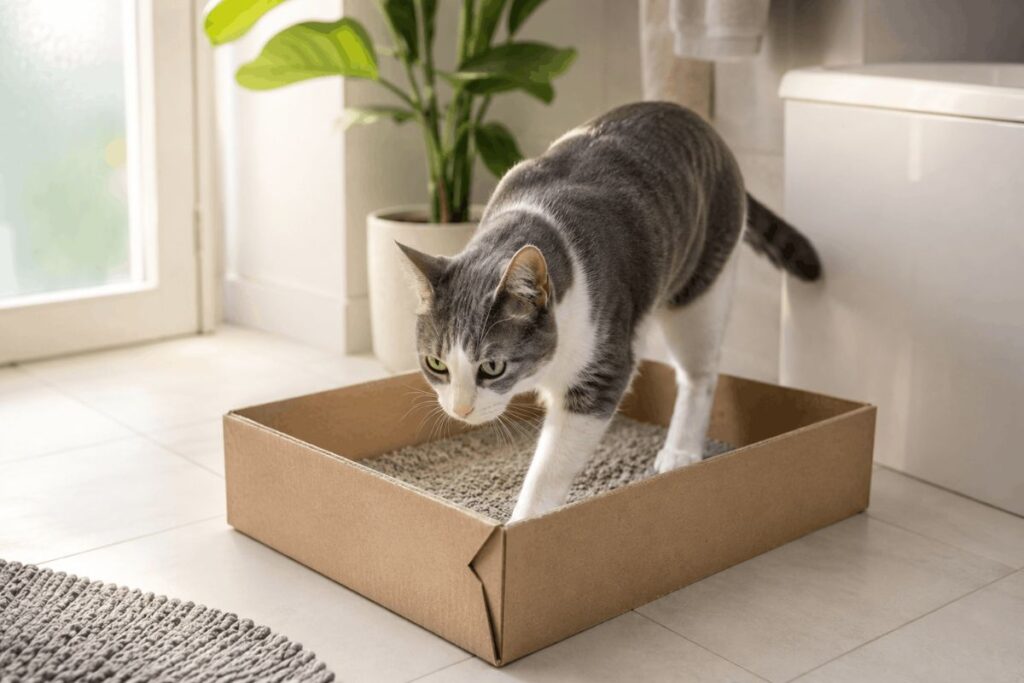
A disposable cat litter box is a litter tray designed to be thrown away after use rather than washed and reused. Most are made from water-resistant cardboard or recycled paper pulp — materials that hold litter and resist liquid long enough to be practical, then break down safely when discarded.
Unlike plastic litter boxes that need vigorous scrubbing with antibacterial products to remove odor and bacteria, a disposable box is simply replaced when it reaches the end of its useful life. Some last three to four weeks. Others are designed for a single trip or a few days of use.
According to Petful’s review team, disposable litter boxes offer a convenient, affordable, and hassle-free litter experience. “Many are made from biodegradable or recycled materials, making them an eco-friendly choice.” You can even find options pre-filled with litter — so you need nothing else to set up a working cat bathroom wherever you are.
Disposable vs Reusable Plastic Litter Box — Honest Comparison
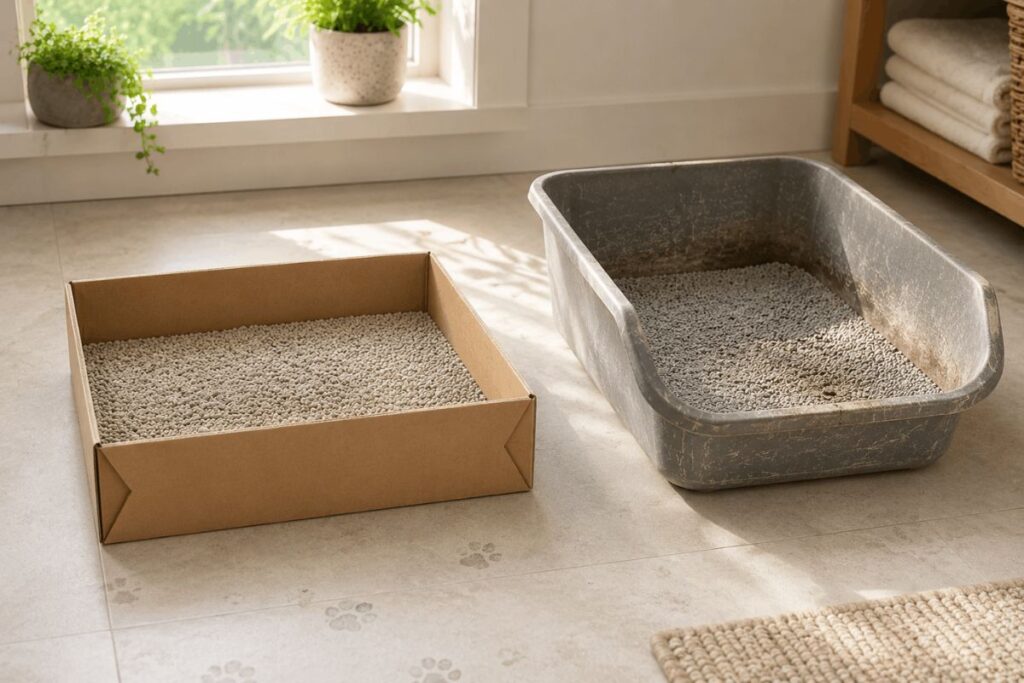
This is the table no competitor includes — and it is exactly what buyers need before making a decision.
| Feature | Disposable Litter Box | Reusable Plastic Litter Box |
| Material | Recycled cardboard / paper pulp | Polypropylene plastic |
| Lifespan | 2–4 weeks per box | 1–5 years |
| Cleaning required | None — just toss and replace | Weekly scrubbing with antibacterial cleaner |
| Bacteria build-up | Minimal — replaced before bacteria accumulate | Significant — scratches in plastic harbor bacteria |
| Odor over time | Lower — replaced frequently | Higher — plastic absorbs odor with age |
| Cost per month | $8–$20 (depending on brand) | $3–$8 (amortized over lifespan) |
| Eco-friendliness | Biodegradable — better than plastic in landfill | Non-biodegradable plastic |
| Best for | Travel, fostering, recovery, temporary use | Permanent home use, multiple cats |
| Not ideal for | Aggressive diggers, very large cats, multi-cat homes | Travel, fostering, cramped spaces |
One frequently missed point: plastic litter boxes develop microscopic scratches over time that trap bacteria, urine proteins, and odor — even with regular cleaning. This is one of the strongest arguments for disposable boxes in a permanent home setting. Cats are sensitive to odor, and a box that smells of old urine even after cleaning may cause litter box avoidance.
Who Should Use a Disposable Litter Box (And Who Should Not)
| Should Use Disposable | Should NOT Use Disposable |
| Frequent travelers with cats | Owners of multiple cats (3+) who use the box heavily |
| Foster cat caregivers | Owners of large cat breeds like Maine Coon (box too small) |
| Cat owners with limited storage space | Cats who are aggressive diggers and scatter heavily |
| Post-surgery or injured cat recovery | Budget-focused owners needing long-term daily use |
| Apartment movers needing temporary solution | Owners who already have a well-maintained permanent box |
| Owners with mobility issues (no scrubbing) | Owners of cats who urinate heavily in one corner |
| Cat owners who hate cleaning the litter box | Power users needing a box that lasts more than a month |
5 Situations Where a Disposable Litter Box Is the Perfect Solution
Disposable litter boxes are not for everyone all the time. But for certain specific situations, they are genuinely the best tool available. Here are the five where they consistently outperform plastic alternatives.
Travel and Road Trips
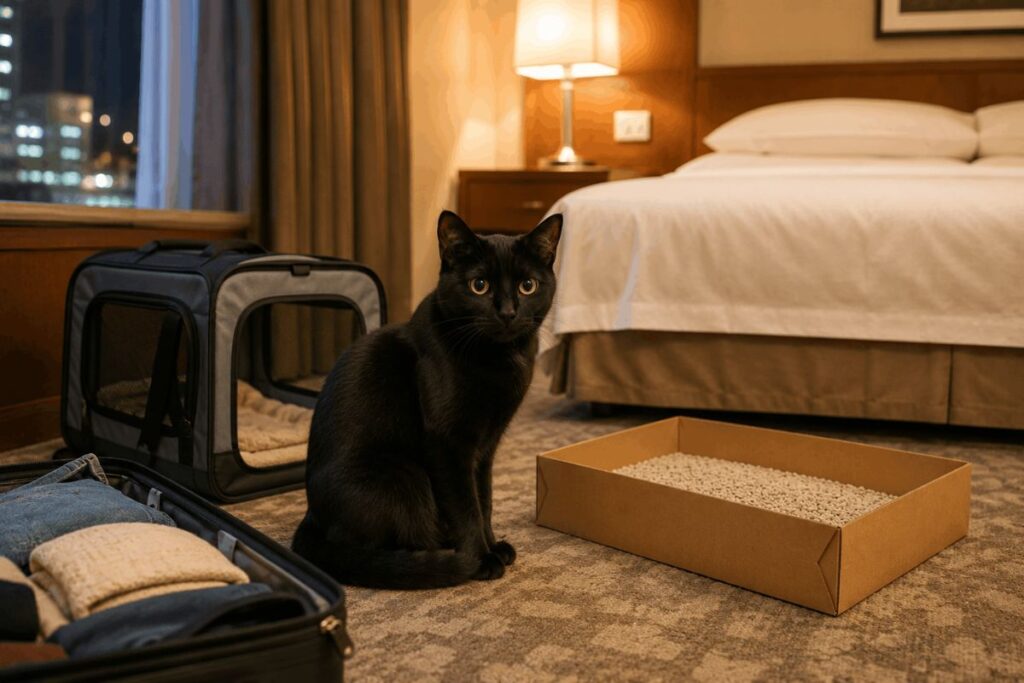
Travel is where disposable litter boxes genuinely shine. They fold flat or pack easily in a suitcase. They weigh almost nothing. And when the trip is over — or when the box needs changing mid-trip — you toss it at any gas station trash can. No hauling a dirty plastic box through airport security or a hotel lobby.
Cats.com’s NAVC-certified reviewer Kate Barrington specifically highlights portability as the primary advantage: disposable boxes are “easy to travel with and set up” and “don’t take up too much room in luggage areas.” For road trips over four hours, a disposable box placed in the back cargo area of the car is the most practical solution available.
Many disposable boxes can also be placed inside your cat’s carrier during layovers — making air travel with cats significantly less stressful for both cat and owner.
Fostering, Rescue, and Temporary Cat Care
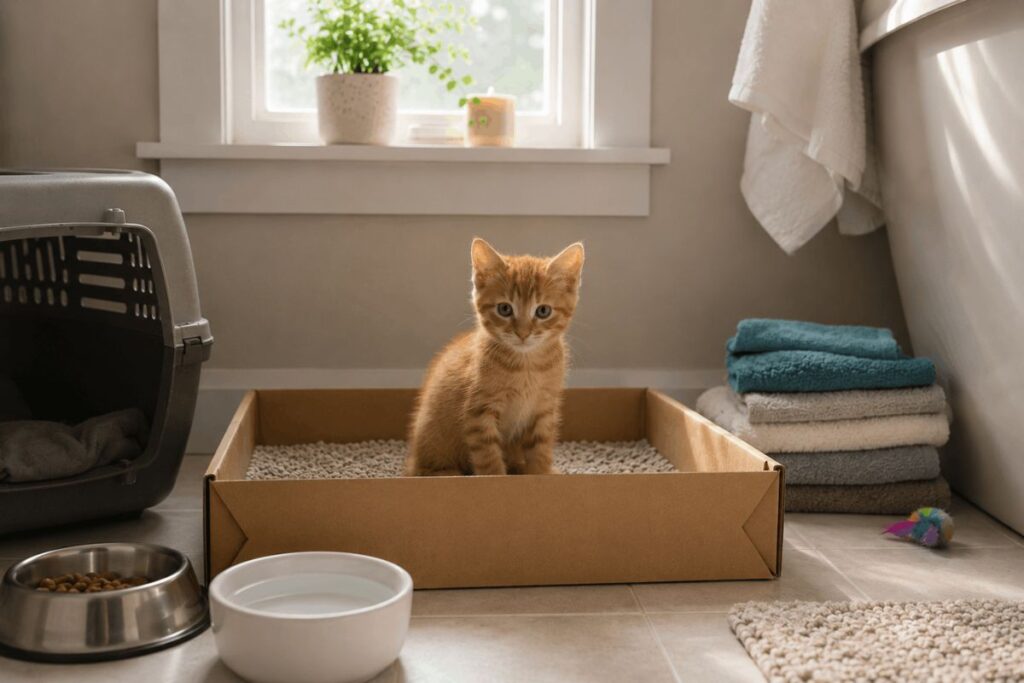
Foster cat caregivers — one of the most underserved groups in cat product marketing — have universally adopted disposable litter boxes as the standard. The reasons are practical:
When a foster cat arrives with an unknown health status, a disposable box means zero cross-contamination risk. When the cat is adopted, the box goes with it or gets discarded — no decontamination of a plastic box required. When the next foster arrives, a fresh, clean box is ready immediately.
Rescue organizations that handle ringworm-positive cats or cats with upper respiratory infections particularly benefit from disposable boxes — the contaminated box is sealed and disposed of cleanly, with no risk of residual infection on reused equipment.
Post-Surgery Recovery and Senior Cat Mobility
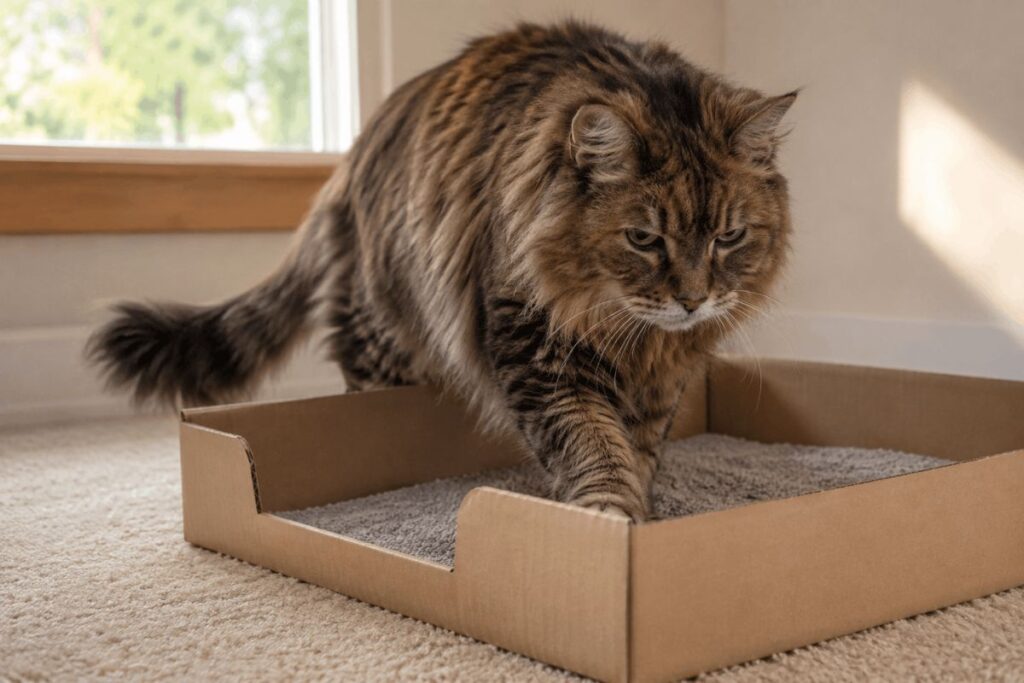
Cats recovering from orthopedic surgery, spay/neuter procedures, or abdominal operations often cannot step over the high sides of a standard litter box. A disposable cardboard box with low sides (typically 3 to 4 inches) solves this problem immediately — and the recovery room setup usually involves a single bathroom or bedroom where a full-size permanent box would be excessive.
Senior cats with arthritis face the same challenge. Petful’s review team notes that disposable boxes “have low sides, combined with their suitability for temporary use, make them perfect for these situations.”
Disposable boxes are also ideal for owners recovering from their own injuries or surgery, or those with mobility conditions that make bending over a traditional litter box difficult. Disposables require no scrubbing, no heavy lifting, and no awkward bending — just toss and replace.
7 Best Disposable Cat Litter Boxes in 2026
Here is the full product comparison before we go into detail:
| Product | Material | Lasts Per Box | Best For | Price Range |
| Kitty Sift Disposable Sifting | 100% recycled cardboard | 3–4 weeks | Best overall, eco-conscious owners | $28–$40/set |
| Kitty’s WonderBox | Recycled cardboard | 3–4 weeks | Budget buyers, temporary use | $8–$12/3-pack |
| Cat’s Pride KatKit | Recycled plastic trays | 1–3 uses per tray | Travel, pre-filled convenience | $15–$20/5-pack |
| Nature’s Miracle Jumbo | Cardboard + baking soda | 3–4 weeks | Large cats, odor-sensitive homes | $12–$18/2-pack |
| PetSafe Collapsible | Wax-coated cardboard | Up to 1 week | Privacy-loving cats, travel | $10–$15 |
| Litter One All-in-One | Recycled cardboard | 3–4 weeks | Plastic-free complete system | $20–$30 |
| Frisco Disposable | Recycled cardboard | 2–3 weeks | Budget-friendly eco option | $7–$10/3-pack |
Best Overall — Kitty Sift Disposable Sifting Litter Box
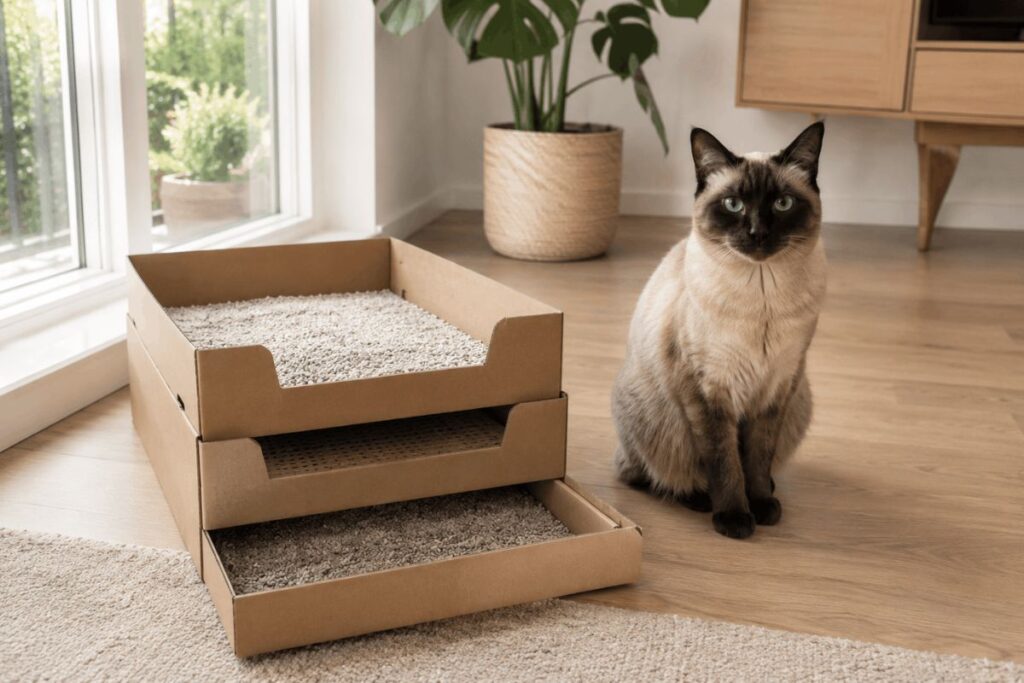
The Kitty Sift is the most reviewed and highest-rated disposable litter box in the USA for 2026. Both Cats.com and Catster independently named it their best overall disposable pick. Its unique multi-tray sifting system sets it apart from all other options on this list.
Here is how it works: a stack of sifting trays sits inside the box. When it is time to clean, you simply lift the top tray — clean litter falls through the angled slits below, and clumps stay behind in the top tray for disposal. The process takes under 30 seconds. No scooping required.
Made from 100% post-consumer recycled cardboard, FSC certified, fully biodegradable, and plastic-free. Cats.com’s Mallory Crusta noted that “our cats gravitated to it immediately and chose it over the other litter boxes offered.” In a single-cat household, it lasts approximately 3 to 4 weeks. Price: $28–$40 per set, available at PetSmart, Petco, Chewy, and Walmart.
Best Budget — Kitty’s WonderBox Disposable Litter Box
For owners who want the disposable concept without the premium price, Kitty’s WonderBox is the clear choice. Hepper’s review team named it the “best disposable litter box for the money” — and at under $12 for a 3-pack, it is hard to argue.
Each box lasts up to a month and is made from recycled cardboard with a water-resistant coating. The main limitation: it does not contain baking soda or any odor-control additive, so if your cat misses the litter, the smell can build. For single-cat households with well-aimed cats, it is a genuinely excellent value. Price: $8–$12 per 3-pack.
Best Pre-Filled — Cat’s Pride KatKit Disposable Trays
The Cat’s Pride KatKit is the only option on this list that comes pre-filled with litter — making it the ultimate zero-setup travel solution. Open the package, place the tray, and done. No litter to carry, no measuring, no mess during setup.
Each kit includes five pre-filled trays made from recycled plastic bottles. The main downside is the plastic — while the bottles are recycled, the trays themselves are not biodegradable, making this the least eco-friendly option on this list. For a long road trip or camping, the convenience trade-off may be worth it. Price: $15–$20 per 5-pack.
Best for Large Cats — Nature’s Miracle Jumbo Disposable Box
Nature’s Miracle Jumbo is the largest cardboard disposable litter box widely available in the USA. Hepper’s review team chose it as the best overall in their test, specifically praising the baking soda infused throughout the cardboard material — a feature that gives it superior odor control compared to uninfused cardboard alternatives.
Available in regular and jumbo sizes. The jumbo accommodates most domestic cat breeds comfortably. Note that Hepper found the corners and ridges slightly harder to scoop than flat-bottomed boxes — something to consider if you prefer traditional scooping over the sifting method. Price: $12–$18 per 2-pack (jumbo).
Best Enclosed — PetSafe Collapsible Disposable Litter Box
Most disposable litter boxes are open trays. The PetSafe Collapsible is the exception — it pops up into a covered, tent-style enclosed box that gives privacy-preferring cats the covered experience they expect. This matters more than most owners realize: a cat accustomed to an enclosed home box may refuse an open tray entirely.
The inside wax coating prevents leaks. Each box lasts approximately one week and comes with PetSafe Crystal Litter and eight disposable scoops. For travel with a cat who only uses covered boxes, this is the only viable disposable option. Price: $10–$15 per box.
What to Look for Before You Buy a Disposable Litter Box
Not all disposable litter boxes perform equally. Three factors determine whether a disposable box will actually work for your cat — or collect dust while she uses the bathroom somewhere else.
Size, Wall Height, and Material — What Actually Matters
Size: Cats.com’s buying guide states the rule clearly — bigger is always better. A cat needs room to enter, turn around, squat, and exit without touching the sides. Most standard disposable boxes are adequate for average domestic cats (8–12 lbs). For large breeds like Maine Coons (12–20 lbs), the Nature’s Miracle Jumbo is the only reliable disposable option.
Wall height: Standard disposable boxes have 3 to 4-inch walls — low enough for kittens, senior cats, and post-surgery cats to enter easily, but low enough that heavy diggers and spray-dominant males may scatter litter beyond the walls. High-sided disposable options are rare — this is one area where disposable boxes genuinely underperform plastic alternatives.
Material: Look for 100% recycled cardboard with a water-resistant coating (wax or polymer-based). Avoid very thin, uncoated cardboard — it absorbs urine and collapses quickly. FSC certification indicates the cardboard was sourced from responsibly managed forests or post-consumer recycled material.
Here is a summary guide:
| Cat Profile | Minimum Box Size | Wall Height | Material Needed |
| Kitten or small cat (under 7 lbs) | 13 x 13 inches | 3 inches | Standard cardboard |
| Average adult cat (7–12 lbs) | 15 x 15 inches | 3–4 inches | Water-resistant cardboard |
| Large cat (12–16 lbs) | 17 x 17 inches | 4+ inches | Reinforced or jumbo cardboard |
| Senior or mobility-limited cat | Any size, low sides | Under 3 inches | Soft-sided or low cardboard |
| Male cat that sprays | Standard size | High sides essential | Consider plastic instead |
What Litter Works Best in a Disposable Box?
Most disposable boxes work with any litter — but some combinations perform better than others. Here is what the experts recommend based on real-world testing.
| Litter Type | Works in Disposable? | Why |
| Clumping clay | ✅ Excellent | Easy scooping, most common, affordable |
| Silica crystal | ✅ Excellent | Best odor control, low moisture = cardboard lasts longer |
| Paper pellet | ✅ Good | Low dust, gentle on cardboard, great for recovery cats |
| Tofu / corn / wheat | ✅ Good | Biodegradable match for eco-conscious users |
| Non-clumping clay | ⚠️ Acceptable | Harder to sift, more moisture reaches cardboard base |
| Heavy tracking clay | ❌ Not ideal | Excess litter outside box defeats the convenience purpose |
Silica crystal litter is particularly well-suited for disposable boxes — it absorbs moisture without clumping, which means less liquid reaches the cardboard base. This extends the usable life of the box significantly.
The Real Owner Story — The Foster Cat That Saved the Carpet
Maria from Denver started fostering cats for a local rescue organization in early 2024. Her first foster — a 6-month-old tabby named Chip — arrived on a Friday evening. The rescue had given Maria a list of supplies, but she had not had time to buy a litter box.
She had a cardboard shipping box in her recycling. She lined it with a garbage bag, added some litter, and put it in the bathroom. Chip used it immediately.
By the time she got to the pet store that weekend, Maria had discovered that actual disposable litter boxes were available for $8 a pack — and she never went back to plastic for fostering. “I’ve fostered 23 cats since then,” Maria said. “Every single one gets a Kitty’s WonderBox. When they leave, I fold it up and it goes in the recycling. Zero cleaning. Zero contamination. Zero stress.”
She now keeps a 3-pack in her closet at all times. Her permanent cats use a plastic box. Her fosters never do.
Are Disposable Cat Litter Boxes Eco Friendly?
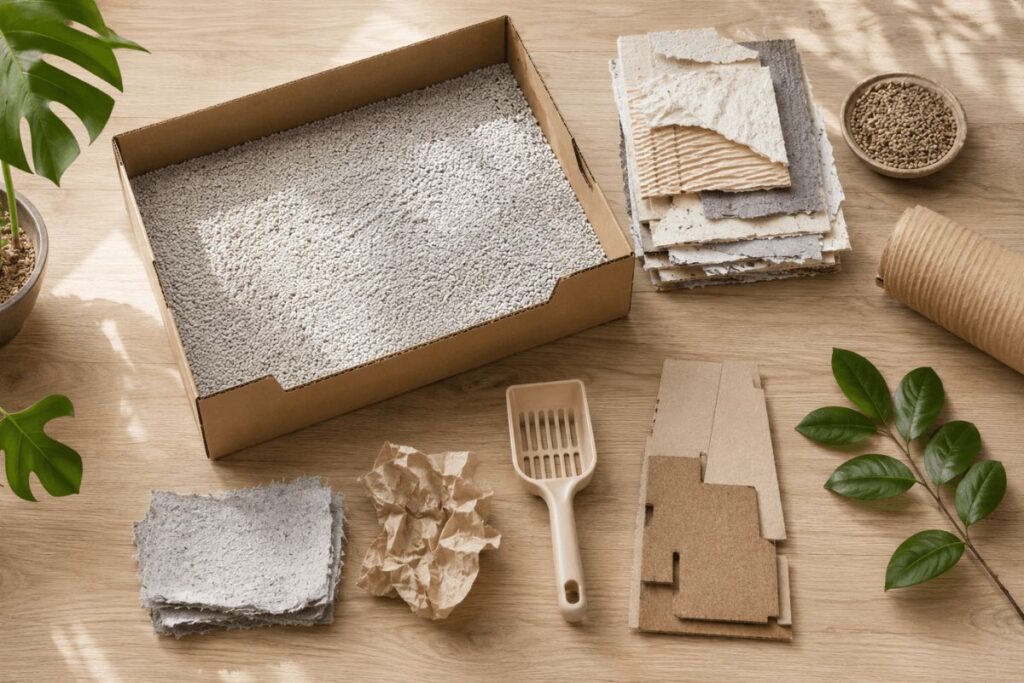
The eco-friendliness of disposable litter boxes is more nuanced than most marketing suggests. Here is the honest breakdown.
Cardboard vs Plastic — The Environmental Truth
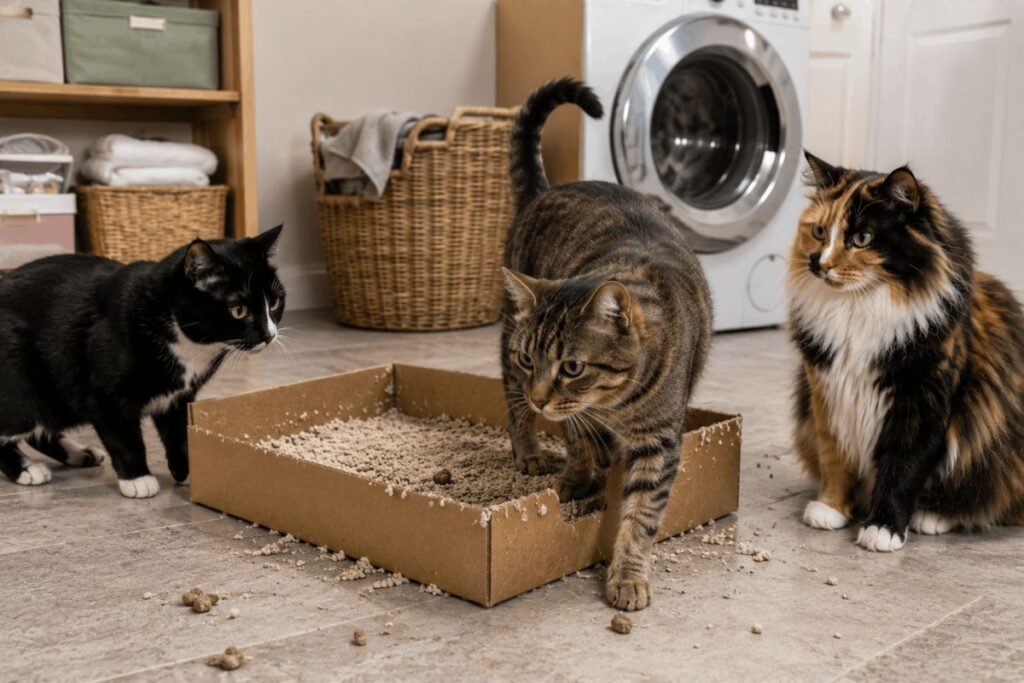
Standard plastic litter boxes are made from polypropylene — a petroleum-derived plastic that takes hundreds of years to break down in a landfill. Each plastic box, when eventually discarded, adds to that permanent waste stream. Most plastic litter boxes are replaced every 1 to 3 years — meaning each household contributes 5 to 15 plastic litter boxes per decade to landfill.
Cardboard disposable litter boxes — specifically those made from 100% post-consumer recycled material with no plastic coating — are genuinely biodegradable. Kitty Sift, Nature’s Miracle, and WonderBox all use FSC-certified recycled cardboard that breaks down in months, not centuries.
However, the frequency matters. A household disposing of one cardboard box per month generates 12 boxes per year. Twelve recycled cardboard boxes have significantly less landfill impact than one plastic box, but they are still 12 boxes. For maximum eco-friendliness, choose boxes with sifting systems (like Kitty Sift) that are designed to last the full 3 to 4 weeks between replacements.
The pre-filled plastic tray options (Cat’s Pride KatKit) are the least eco-friendly in this category — the plastic trays, though made from recycled bottles, are not biodegradable. If environmental impact matters to you, stick with cardboard.
Final Thought
A disposable cat litter box is not a replacement for a permanent home litter setup — but it is not trying to be. It is a practical, clean, often eco-friendly solution to specific situations where a plastic box either does not make sense or simply does not work.
For travel, fostering, recovery, or anyone who dreads the bi-weekly deep clean of a standard box — disposable is worth every dollar. Start with the Kitty Sift if the budget is flexible, or the WonderBox if you want simple and affordable. Use silica or clumping clay litter for best results, and replace the box every three to four weeks for optimal hygiene.
Sometimes the most elegant solution is also the most disposable one.
Frequently Asked Questions
Are disposable cat litter boxes worth it?
Yes — they are great for travel, fostering, recovery, or temporary use, but reusable boxes are cheaper long term.
How long does a disposable cat litter box last?
Most last 2–4 weeks for one cat with daily scooping, but multi-cat homes need faster replacement.
What is the best disposable cat litter box?
Kitty Sift is one of the top-rated options because it is eco-friendly, easy to clean, and lasts longer than most.
Are disposable litter boxes eco friendly?
Cardboard disposable boxes are more eco-friendly than plastic since they biodegrade much faster.
Can you use a disposable litter box every day?
Yes, many cat owners use them daily and replace them every few weeks, depending on usage.

Wahsay Ahmed is the founder of FelineNest and a cat care writer. His interest in feline health began in 2023 after adopting two cats, Whisker and Mochi. Since then, he has spent two years studying trusted veterinary resources, feline behavior, nutrition, and preventive care while applying that knowledge through daily care of his own cats.