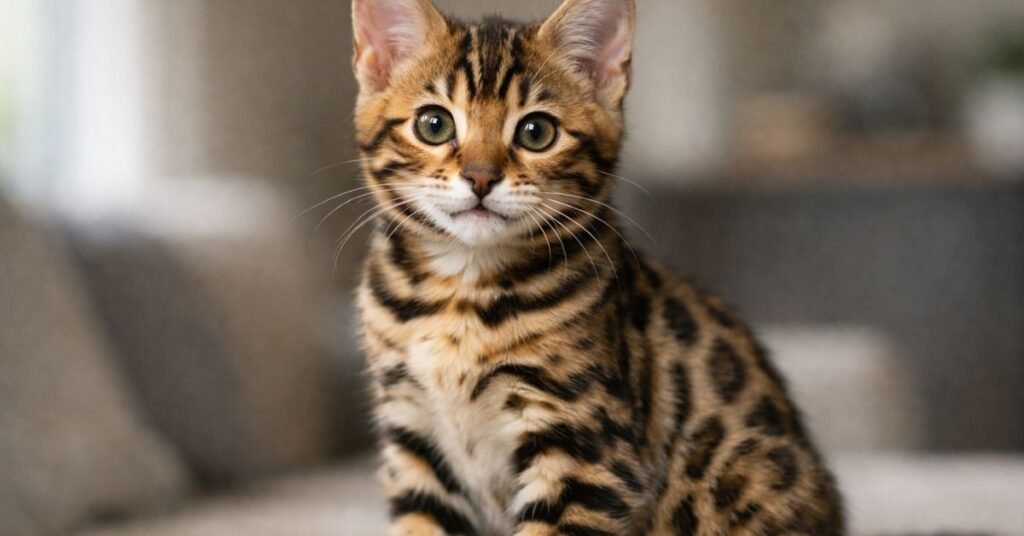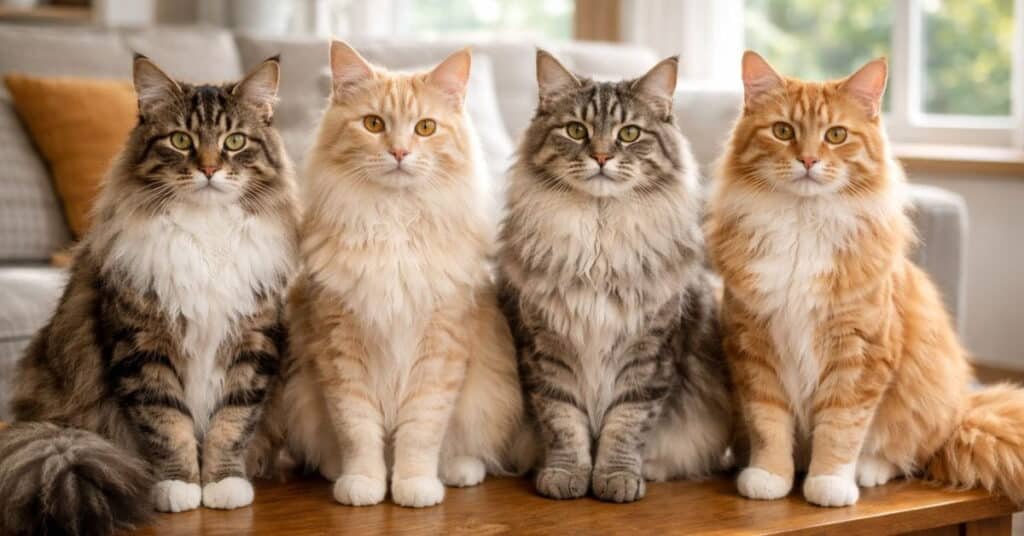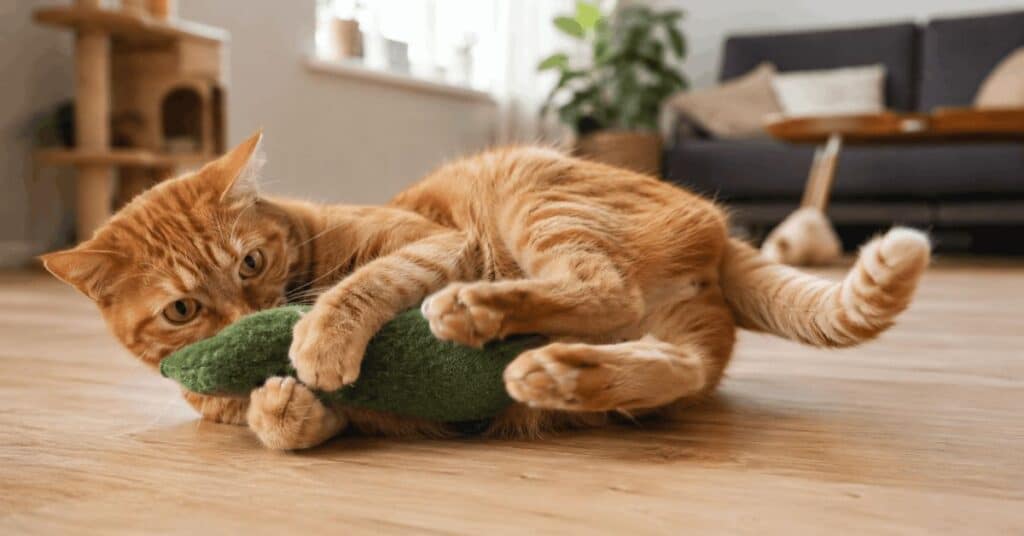
A cat kicker toy is a long, stuffed, grippable toy — typically 9 to 16 inches — designed so your cat can grab it with her front paws and kick it vigorously with her hind legs. They are sometimes called kick sticks, bunny kick toys, or catnip kickers. According to Chewy’s pet behavior team, kicker toys are “designed so cats can grab onto them with their front paws and bunny kick them with their hind legs” — engaging the complete predatory play sequence in a single toy.
The key design feature is proportion: narrow enough for your cat to wrap her front paws around, but long enough to reach her back feet for a full kicking motion. Get this wrong, and your cat will ignore the toy entirely.
The Science Behind the Bunny Kick — Why Your Cat Does This
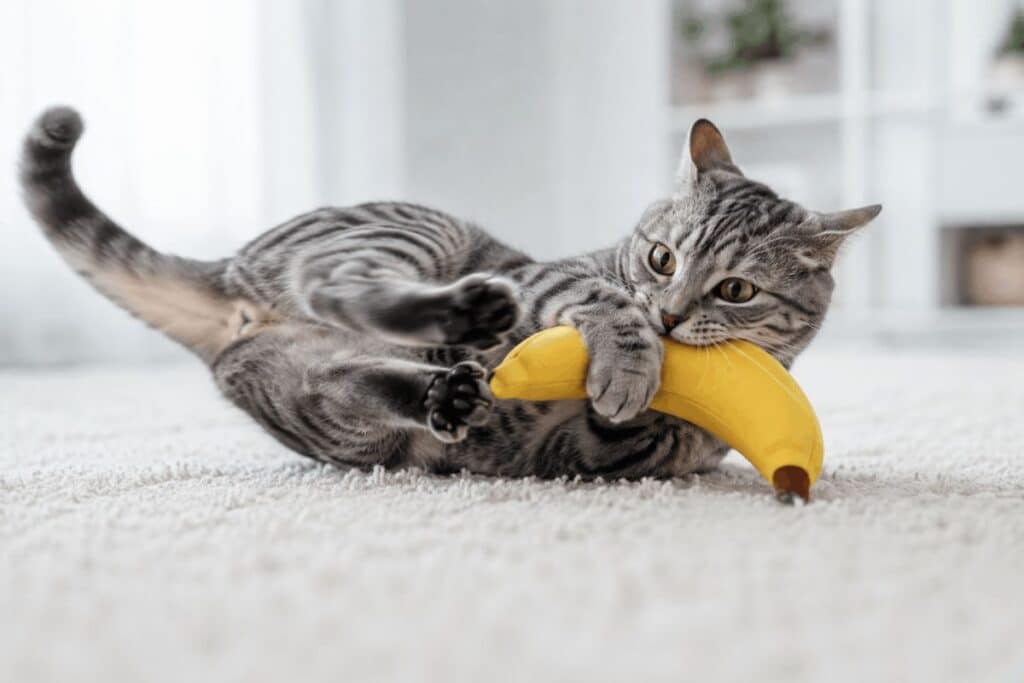
The bunny kick is not random. It is a deeply ingrained predatory behavior rooted in how wild cats kill prey. Furtropolis (Outward Hound) explains it clearly: when a big cat is in a fight or hunting and gets pinned on its back, the most vulnerable area — the belly — is exposed. Their defense is to aggressively use their hind legs to kick the opponent away.
This same hind-leg-raking motion is used by wild cats to finish off prey after grabbing it. For a domestic cat, the bunny kick is the final step in the hunt–catch–kill sequence. When your cat grabs a kicker toy and rakes it with her back feet, she is completing an instinctive behavioral loop that her nervous system is wired to want.
Dr. Abel Gonzalez, clinical director at Dutch, a pet telehealth platform, confirms that toys prompting these natural predatory behaviors are “mentally and physically stimulating” for cats. The bunny kick is not aggression — it is fulfillment.
5 Real Benefits of Cat Kicker Toys Most Owners Don’t Know
OfficialFloppyFish.com’s veterinary research team outlines the benefits that go well beyond simple entertainment:
1. Full-body workout. A vigorous 5-minute bunny kicking session burns as many calories as 15 minutes of casual play with smaller toys. The hind legs, core, and shoulder muscles all engage simultaneously.
2. Hind leg muscle strengthening. The kicking motion specifically strengthens muscles that rarely get exercised during normal jumping or walking — supporting better joint health and mobility as cats age.
3. Stress and cortisol reduction. Completing the predatory sequence — stalk, grab, kick — releases endorphins and reduces cortisol. This is especially valuable for indoor cats, anxious cats, and cats in multi-cat households.
4. Mental fulfillment. When your cat “captures” and subdues her kicker toy, she experiences the satisfaction of a completed hunt. This mental fulfillment is something wand toys and balls cannot provide in the same way.
5. Play aggression redirection. Cats who bite and kick human hands and arms are not being aggressive — they are looking for an appropriately sized kicking target. A kicker toy redirects this behavior immediately and effectively.
Catnip vs Silvervine — Which Filling Actually Works Better?
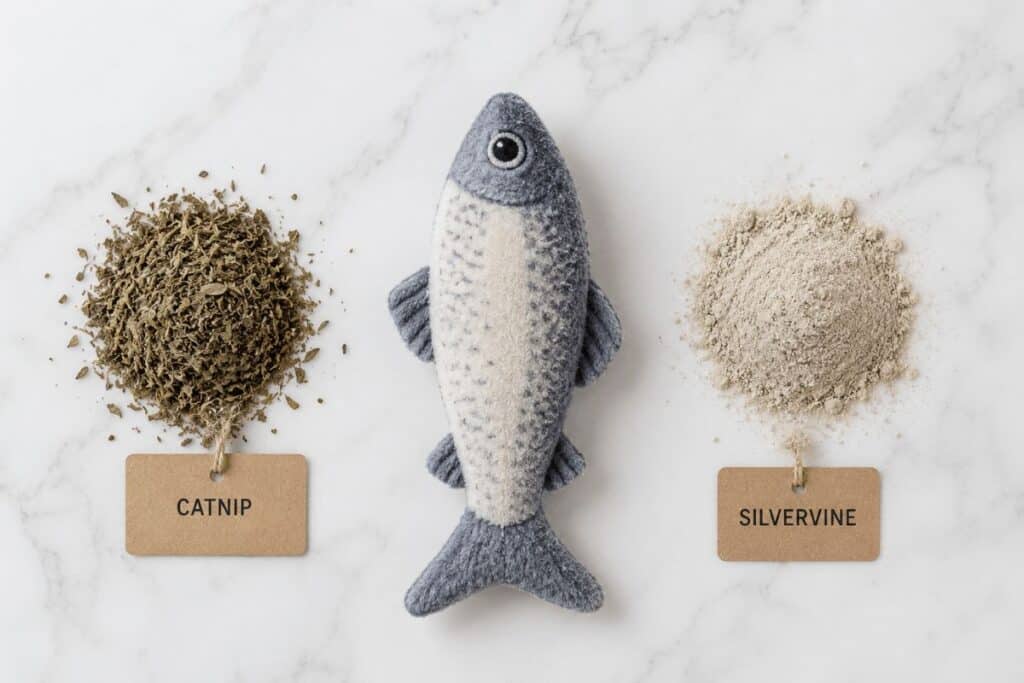
Most cat kicker toys are filled with either catnip, silvervine, or a blend of both. The filling is what triggers your cat’s interest — and choosing the wrong one means the toy sits ignored in the corner.
Catnip is the most widely known. It contains nepetalactone — a compound that binds to feline scent receptors and produces a mild euphoric response. According to Kitty Kick Stix, approximately 50 to 75 percent of cats respond to catnip. The response is genetic — kittens under six months and cats who lack the catnip receptor gene show no reaction at all.
What Is Silvervine and Why Some Cats Prefer It Over Catnip
Silvervine (Actinidia polygama) is a plant native to Asia that contains two active compounds — actinidine and dihy droactinidiolide — both of which trigger a response in cats. Unlike catnip’s single active compound, silvervine’s dual compounds make it effective in cats who do not respond to catnip.
| Feature | Catnip | Silvervine | Catnip + Silvervine Blend |
| Active compound(s) | Nepetalactone (1) | Actinidine + dihydroactinidiolide (2) | Both |
| % of cats that respond | 50–75% | Up to 80% | Highest response rate |
| Response intensity | Moderate | Often stronger | Very strong |
| Duration of effect | 10–15 minutes | 20–30 minutes | 15–25 minutes |
| Potency over time | Fades — needs refreshing | Stays potent longer | Moderate fade |
| Best for | Most cats | Catnip-insensitive cats | Maximum engagement |
| Refillable needed? | Yes — fades in weeks | Less urgent — lasts longer | Yes |
Rover.com notes that silvervine blends “may appeal even to cats that don’t react to catnip” — and real-world reviews consistently show cats who ignored catnip toys responding enthusiastically to silvervine. If your cat has shown zero interest in catnip kicker toys in the past, try silvervine before giving up on kicker toys entirely.
Refillable vs Non-Refillable — Which Is Worth the Extra Cost?
Catnip and silvervine lose potency over time as volatile oils evaporate. Most kicker toys will become less attractive to your cat within 4 to 8 weeks, regardless of how well they are made.
| Feature | Refillable Kicker | Non-Refillable Kicker |
| Long-term value | Excellent | Poor |
| Initial cost | Slightly higher | Lower |
| Catnip replacement cost | $3–$8 per refill | Full toy replacement |
| Ease of use | Velcro or zipper pocket | No action needed |
| Best for | Long-term owners | Travel, gifting, testing |
| Cat engagement over time | Consistently high | Drops off in 4–8 weeks |
For any cat you plan to keep engaged for months, a refillable kicker toy is always worth the few extra dollars. Zipper pockets are easier to use than Velcro and prevent catnip from falling out during aggressive play.
8 Best Cat Kicker Toys in 2026
Here is the full comparison before we go into detail:
| Product | Length | Filling | Refillable | Best For | Price |
| Petstages Magic Dynamite | 9 inches | Catnip | ❌ No | Best overall | $5–$8 |
| Potaroma Flopping Fish | 11 inches | Silvervine + motion | ✅ Velcro | Electronic/motion lovers | $18–$25 |
| Petlinks HappyNip Fun Fins | 16.25 inches | Catnip + silvervine | ❌ No | Large cats | $10–$15 |
| Yeowww! Banana | 7 inches | Organic catnip | ❌ No | Small cats | $6–$10 |
| Jackson Galaxy Kicker | 13 inches | Organic catnip | ❌ No | Premium quality | $12–$18 |
| Mad Cat Big Cactus | 8 inches | Catnip + silvervine | ❌ No | Budget + dual filling | $5–$8 |
| Kitty Kick Stix Classic | 15 inches | Catnip + silvervine | ✅ Velcro | Long-term use | $10–$15 |
| TwinCritters Kicker Set | 11 inches | KittiKrack silvervine | ✅ Zipper | Best refillable | $16–$22 |
Best Overall — Petstages Magic Dynamite Catnip Kicker
Rover.com named the Petstages Magic Dynamite their best overall cat kicker toy — and the reasoning is solid. Its 9-inch length and narrow tube shape hit the exact proportions most cats prefer for bunny kicking. It is narrow enough for the front paws to grip fully, and long enough for the back feet to reach.
The durable polyester material resists snagging on claws better than most fabric options — a meaningful advantage for cats who kick aggressively. The catnip filling is premium quality, and when the scent fades, you can squeeze or roll the toy to crush the dried leaves and release fresh potency. At $5 to $8, it is the most cost-effective starting point for any cat owner trying kicker toys for the first time. Price: $5–$8, available at Amazon, Chewy, and PetSmart.
Best Electronic — Potaroma Flopping Fish Motion-Activated Kicker
Over 44,300 Amazon reviews — the Potaroma Flopping Fish is the most reviewed electronic kicker toy on the market. It uses a motion-activated motor to create realistic flopping fish movement that triggers a cat’s predatory drive, even in cats who show little interest in static plush toys.
Rover.com’s test cat was “a fan, as was his pup sibling.” The USB-rechargeable design provides 2 to 3 days of play per charge and maintains consistent movement throughout — unlike battery-powered versions that weaken as batteries drain. The silvervine Velcro refill pouch keeps the toy attractive between motion sessions. OfficialFloppyFish.com notes that motion-activated toys are particularly effective for “cats who ignore static toys.” Price: $18–$25, available at Amazon, Chewy, and Walmart.
Best for Large Cats — Petlinks HappyNip Fun Fins Kicker
At 16.25 inches, the Petlinks HappyNip Fun Fins is the longest mainstream kicker toy available. For large cats — Maine Coons, Norwegian Forest Cats, Ragdolls — standard 9 to 11-inch kickers are simply too short for the back feet to get full kicking motion.
The Fun Fins tapers from a wider hugging end to a narrower kicking end, allowing large cats to grip the body firmly while their back feet can still rake the tail section. The burlap and plush material combination provides texture variety, and the catnip and silvervine blend ensures high response rates. Rover.com cites it as the best large cat option on the market. Price: $10–$15, available at Chewy and Amazon.
Best for Small Cats — Yeowww! Catnip Banana Kicker
Small cats and kittens need shorter, lighter kicker toys they can physically wrap around and control. The Yeowww! Banana is 7 inches long — the ideal size for cats under 8 pounds. It is made from durable cotton twill dyed with natural plant-based color and stuffed with organic catnip.
With over 24,000 Amazon ratings, the banana is one of the most beloved cat toys in the USA. Reviewers consistently praise its durability — significantly longer-lasting than average cotton toys. The only downside: it is not refillable. For a small cat with a strong catnip response, expect to replace every 2 to 3 months as the scent fades. Price: $6–$10, available at Amazon, Chewy, and independent pet stores.
Best Premium — Jackson Galaxy Kicker Toy
Jackson Galaxy — the cat behaviorist and television host — designed this kicker with a specific feature that sets it apart: the toy is structured to “kick back” during play, creating the sensation of kicking a responsive prey animal rather than a static object. For cats with high prey drive, this sensory feedback significantly increases engagement.
At 13 inches long, it suits most adult domestic cats comfortably. The organic catnip filling is high-quality, and the materials are durable enough to withstand sustained aggressive play. Cuteness.com specifically recommends it for adult cats because of its size and the dynamic kick-back feature. Price: $12–$18, available at Amazon and specialty pet stores.
Best Budget — Mad Cat Big Cactus Catnip & Silvervine Kicker
The Mad Cat Big Cactus combines catnip and silvervine filling with a crinkled interior — creating a multi-sensory experience at a budget price. At $5 to $8, it is one of the most affordable dual-filling options available. The cactus shape appeals to cats’ visual hunting instinct, and the crinkle sound adds an auditory stimulation layer.
Chewy reviewer Frank noted that the crinkle sound acts like a “Churu tube being opened — they all come running when they hear Cactus Man’s crinkle.” The main limitation: it measures only 8 inches, which may be too short for large cats. Ideal for average-sized cats who respond well to sound and scent combined. Price: $5–$8, available at Chewy and PetSmart.
How to Choose the Right Cat Kicker Toy
Most owners buy the wrong kicker toy because they focus on design rather than dimensions. Your cat’s size determines the toy’s length requirement — and getting this wrong means the toy gets ignored.
Size and Length Guide — The Most Important Factor
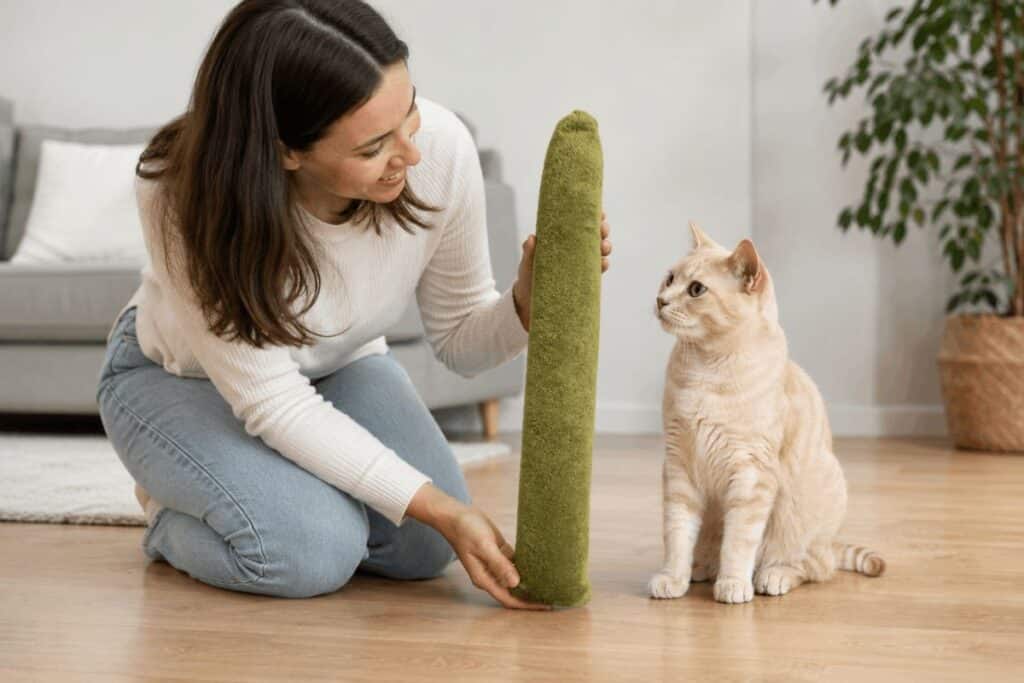
Rover.com states the rule clearly: “Length is an important factor to consider in a kicker toy for cats, and smaller bodies require smaller toys.” A toy that is too long cannot be gripped and kicked simultaneously. A toy that is too short does not allow full kicking motion.
| Cat Size | Weight | Body Length | Recommended Kicker Length |
| Kitten | Under 4 lbs | Under 10 inches | 6–8 inches |
| Small adult cat | 4–8 lbs | 10–14 inches | 7–10 inches |
| Average adult cat | 8–12 lbs | 14–18 inches | 9–13 inches |
| Large adult cat | 12–16 lbs | 18–22 inches | 13–16 inches |
| Giant breed (Maine Coon) | 16+ lbs | 22+ inches | 16+ inches |
The width matters too. Rover.com specifies the toy must be “narrow enough that your cat can get their legs all the way around it.” If the toy is too wide to grip — even at the right length — your cat cannot complete the bunny kick motion properly.
Types of Cat Kicker Toys — Which Style Suits Your Cat?
| Kicker Type | Description | Best For | Not Ideal For |
| Classic plush tube | Simple elongated stuffed toy, catnip or silvervine filled | First-time kicker, most cats | Cats who need motion stimulus |
| Electronic / motion-activated | Built-in motor creates flopping or wiggling | High-energy cats, cats who ignore static toys | Noise-sensitive cats, small spaces |
| Fish-shaped kicker | Realistic fish design, often electronic | Cats with strong prey drive | Cats who prefer fabric texture |
| Banana / novelty shape | Shorter, food-shaped catnip toys | Small cats, kittens | Large cats — too short |
| Crinkle kicker | Sound-producing interior + catnip | Cats motivated by sound | Cats who dislike noise |
| Refillable kicker set | Multiple trays, replaceable catnip pockets | Long-term owners, rotation play | Single-use situations |
The Real Owner Story — The Cat Who Stopped Attacking Arms
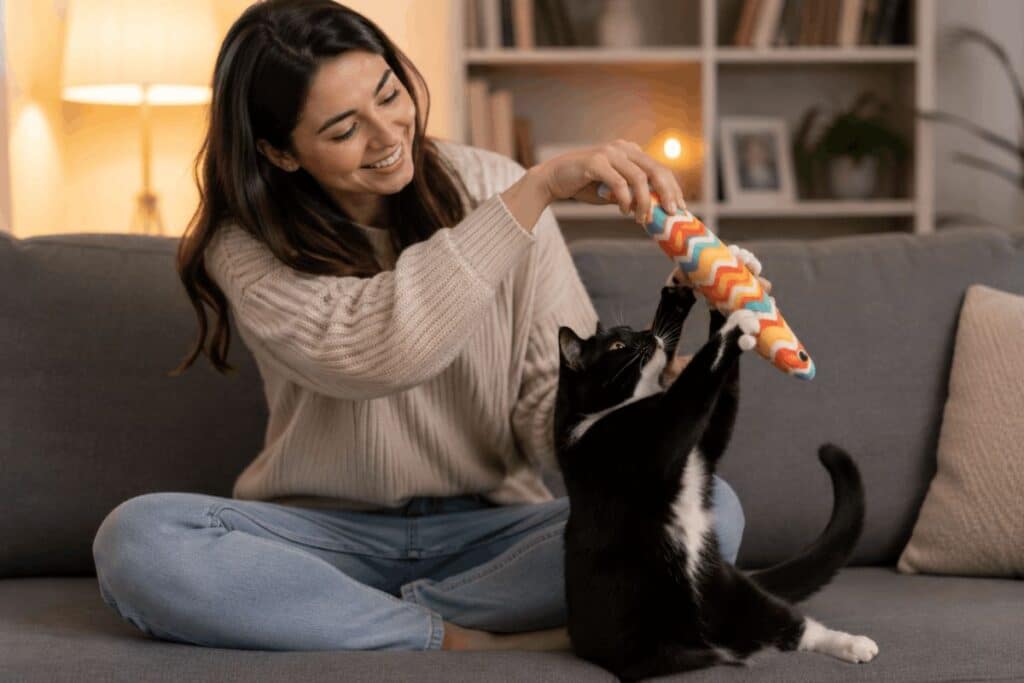
Sarah from Austin adopted a two-year-old tabby named Rocket in March 2025. Rocket was loving, affectionate, and obsessed with attacking human arms. Every evening on the couch, Rocket would launch herself at whoever was nearest — grabbing with front paws and kicking furiously with her back legs. The scratches were real and getting worse.
A vet tech friend suggested a kicker toy before recommending any behavioral intervention. Sarah ordered a Petstages Magic Dynamite for $6. She tossed it toward Rocket during the next couch session.
Within three minutes, Rocket had abandoned Sarah’s arm entirely and was vigorously bunny-kicking the dynamite toy across the living room floor.
“It was immediate,” Sarah said. “She needed something to kick. She didn’t want to hurt me — she just had nowhere to put that energy.”
Rocket now has four kicker toys in rotation. The arm attacks stopped within one week. The toys cost $24 total. “Best $24 I’ve ever spent on a cat,” Sarah said.
How to Get Your Cat Interested in a Kicker Toy
Some cats attack a kicker toy on first contact. Others need a little encouragement. If your cat shows initial disinterest, try these proven techniques before giving up:
Drag, don’t drop. Place the toy on the floor and drag it slowly away from your cat — do not just drop it in front of her. Moving away from the cat mimics fleeing prey and triggers the chase instinct more reliably than a stationary toy.
Rub with catnip or silvervine first. If the toy came without filling or you have a catnip-sensitive cat, rub fresh catnip or silvervine powder directly on the exterior before introducing the toy. The scent primes the predatory response.
Try a different filling. If your cat ignores catnip kickers entirely, the issue is almost always genetics — they lack the catnip receptor. Switch to silvervine and you will often see an immediate difference.
Introduce during peak energy time. Most cats have peak predatory energy in the early morning and evening. Introducing a new toy at 2 p.m. when your cat is half-asleep will get a much weaker response than the same toy introduced at 7 p.m. when she is alert and active.
Rotate toys. Cats habituate to familiar toys — even beloved ones. Keep 3 to 4 kicker toys in rotation, bringing out a different one every few days so each feels novel and interesting.
My Personal Experience
I noticed that a cat ignored small toys but immediately enjoyed a long kicker toy. She could grab it with her front paws and kick it with her back legs. Rotating the toy every few days also kept her interested.
Safety Tips — What to Watch for During Kicker Play
Kicker toys are among the safest cat toys available — but a few safety checks are worth making:
- Inspect regularly for damage. Aggressive kickers can puncture plush toys over time. Remove any toy with holes large enough to pull out stuffing — ingested poly-fill is a choking and obstruction risk.
- Avoid small attached pieces. Feathers, plastic eyes, and dangling strings can break off. Choose kicker toys where decorative elements are securely stitched rather than glued.
- Supervise electronic toys. Motion-activated kickers with batteries or charging components should be supervised to ensure the motor housing remains intact.
- Replace when fully defeated. A kicker toy that has been ripped, flattened, or emptied of filling has served its purpose. Replace it — a depleted toy is less engaging and potentially less safe.
Final Thought
A cat kicker toy solves three problems at once: it gives your cat’s bunny-kicking instinct a safe outlet, provides physical exercise that indoor cats desperately need, and stops the arm-and-ankle attacks that most owners assume they just have to accept.
The right toy for your cat is not necessarily the most expensive one. It is the one that is the right length for her body, filled with the stimulus she responds to — catnip or silvervine — and available when she needs it. Start with the Petstages Magic Dynamite at $6 if you are unsure. If she ignores it, try the Potaroma Flopping Fish for motion stimulus. If she still ignores it, switch to silvervine.
One of those three will work. And when it does, you will wonder how you managed without it. For more information about safe cat toys and play, visit ASPCA Cat Care Guide.
Frequently Asked Questions
Why do cats bunny kick their toys?
It is a natural hunting instinct — in the wild, cats use their hind legs to disable prey after grabbing it. A kicker toy gives this instinct a safe outlet.
What is a cat kicker toy?
A long, stuffed, grippable toy — usually 7 to 16 inches — designed for cats to grab with their front paws and kick vigorously with their hind legs, often filled with catnip or silvervine.
Do cat kicker toys really work?
Yes — for most cats, they are one of the most effective toys available. Cats who bite and kick human arms almost always redirect to a properly sized kicker toy immediately.
What is the best filling for a cat kicker toy — catnip or silvervine?
Catnip works for 50 to 75 percent of cats. Silvervine works on more cats and lasts longer. If your cat ignores catnip toys, try silvervine — it almost always gets a reaction.
How long should a cat kicker toy be?
Match the length to your cat’s size. Small cats need 6 to 8 inches, average cats 9 to 13 inches, large cats 13 to 16 inches, and giant breeds like Maine Coons need 16 inches or more.

Wahsay Ahmed is the founder of FelineNest and a cat care writer. His interest in feline health began in 2023 after adopting two cats, Whisker and Mochi. Since then, he has spent two years studying trusted veterinary resources, feline behavior, nutrition, and preventive care while applying that knowledge through daily care of his own cats.