
Wondering how old your kitten really is? This complete kitten age chart helps you identify a kitten’s age by eyes, teeth, weight, and development stages from birth to 12 months. A tiny kitten can change dramatically in just a few days. If you found a stray kitten or adopted one without knowing its birthday, this kitten age chart helps you estimate age fast using eyes, teeth, weight, and behavior.
| Age | Eyes | Ears | Teeth | Weight | Behavior |
| Newborn (0-7 days) | Closed | Folded flat | None | 3-5 oz (85-140g) | Sleeping, nursing only |
| 1 week | Starting to open (slit) | Still folded | None | ~4-6 oz | Wiggling, very limited movement |
| 2 weeks | Fully open — baby blue | Starting to unfold | None | 7-9 oz (200-250g) | Wobbly attempts at walking |
| 3 weeks | Open — blue, improving | Upright and open | Incisors emerging | 10-12 oz (280-350g) | Walking, litter box exploring |
| 4 weeks | Open — blue | Fully upright | Canines emerging | 12-16 oz (350-450g) | Running, playing, using litter box |
| 5 weeks | May show color change | Fully upright | Premolars emerging | 16-18 oz (450-510g) | Confident running, weaning starting |
| 6 weeks | Eye color changing | Adult shape | All baby teeth nearly complete | 18-20 oz (510-565g) | Social play, jumping short distances |
| 7 weeks | Adult color emerging | Adult | All baby teeth present | 21-24 oz (595-680g) | Fully weaned, playing confidently |
| 8 weeks | Adult color set | Adult | Full baby teeth set | 24-32 oz / ~2 lbs | Eating independently, ready to adopt |
| 3 months | Adult | Adult | Baby teeth, some adult incisors | ~3 lbs | Juvenile energy, vaccinations due |
| 4 months | Adult | Adult | Adult teeth replacing baby | ~4 lbs | Teething, high energy |
| 5 months | Adult | Adult | Adult teeth mostly present | ~5 lbs | Near sexual maturity |
| 6 months | Adult | Adult | Full adult teeth | ~6 lbs | Adolescent, spay/neuter window |
| 12 months | Adult | Adult | Adult — tartar may appear | 8-10 lbs avg | Full adult — considered grown |
How to Tell a Kitten’s Age — 4 Methods That Actually Work

Casey Seleman, a veterinary technician at Woodstock Animal Hospital in Woodstock, New York, explains that eyes are the first thing professionals look at: “If you bring a kitten into the clinic and their eyes are still blue, we know that kitten should be with their mother.” Beyond that, teeth, weight, and behavior narrow the estimate further.
Method 1 — Eyes (Most Reliable for Young Kittens)
The eye is the single fastest age indicator for kittens under 8 weeks. Here is exactly what to look for:
| Eye Appearance | Estimated Age |
| Eyes completely closed | Under 10 days |
| Eyes beginning to open (narrow slit) | 7-10 days |
| Eyes fully open — entirely baby blue | 2-6 weeks |
| Blue eyes with a halo of new color around the pupil | 6-8 weeks |
| Eye color fully transitioned to adult color | 8+ weeks |
| Eyes clear and bright with sharp pupils | Under 7 years (adult) |
| Slight bluish haze on the lens | 8+ years (nuclear sclerosis) |
According to Chewy’s veterinary team, “eye color changes begin around the pupil and spread outward. If your kitten has a brown, green, or hazel halo around their pupils, the kitten is likely 6-8 weeks old.” This simple observation takes about three seconds and provides reliable age narrowing.
Limitation: Eye development can be slower in malnourished kittens. A poorly nourished 8-week-old may still have blue eyes and appear to be 5-6 weeks old based on eye development alone.
Method 2 — Teeth (Most Reliable for 3-Week to 6-Month Kittens)
Teeth are the most reliable age indicator from 3 weeks onward. The ASPCA uses teeth as its primary aging method for kittens past the newborn stage.
| Teeth Appearance | Estimated Age |
| No teeth visible | Under 3 weeks |
| Tiny incisors just emerging at gum line | 3 weeks |
| Incisors present, canines beginning | 4 weeks |
| Incisors + canines present, premolars starting | 5 weeks |
| All baby teeth present and fully erupted | 7-8 weeks |
| Baby teeth present, first adult incisors appearing | 3-4 months |
| Mix of baby and adult teeth — teething | 4-5 months |
| Full adult teeth, no baby teeth remaining | 6-7 months |
| Adult teeth with slight yellowing or tartar | 2+ years |
| Significant tartar, possible worn teeth | 5+ years |
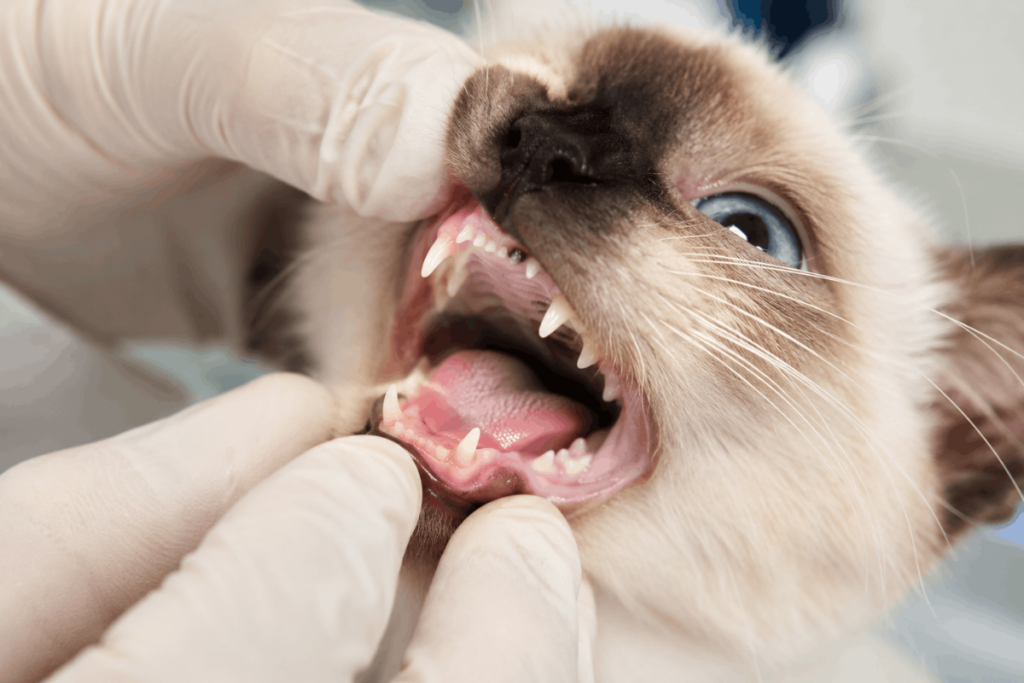
How to tell baby vs adult teeth: Baby teeth are slightly smaller with sharp, pointed tips. Adult teeth are wider with flat edges. When both types are present simultaneously during teething (4-6 months), the difference is immediately obvious — adult teeth look proportionally larger beside the remaining baby teeth.
Method 3 — Weight (Useful Until About 10 Weeks)
Weight is the quickest rough estimate when a kitten is too squirmy for a close physical examination. The ASPCA and Kinship both confirm this rule: one pound of body weight corresponds to approximately one month of age, up to about 5 months. This gives you a fast ballpark figure.
| Weight | Approximate Age |
| 3-5 oz (85-140g) | Newborn (0-7 days) |
| 7-9 oz (200-250g) | 2 weeks |
| 10-12 oz (280-340g) | 3 weeks |
| 12-16 oz (340-450g) | 4 weeks / ~1 pound |
| 1.5-1.75 lbs (680-800g) | 5-6 weeks |
| 2 lbs (900g) | 8 weeks |
| 2.5 lbs (1.1 kg) | 10 weeks |
| 3 lbs (1.4 kg) | 12 weeks / 3 months |
| 4-5 lbs (1.8-2.3 kg) | 4-5 months |
| 6-8 lbs (2.7-3.6 kg) | 6-8 months |
| 8-10 lbs (3.6-4.5 kg) | 10-12 months (near adult weight) |
Important caveat: Weight is unreliable in malnourished kittens. An 8-week-old kitten who was not properly fed may weigh only 1.2 lbs — a weight that would suggest 4-5 weeks in a well-nourished kitten. Use weight alongside eyes and teeth for the most accurate estimate.
Method 4 — Behavior and Mobility (Best Supporting Evidence)
Behavior and mobility provide the fastest rough estimate when nothing else is visible. These milestones are consistent across all breeds:
| Behavior Observed | Estimated Age |
| Only sleeping and nursing — no movement | Under 1 week |
| Wiggling, limited crawling | 1-2 weeks |
| First wobbly walking attempts | 2-3 weeks |
| Walking steadily, beginning to play | 3-4 weeks |
| Running, playing confidently | 4-5 weeks |
| Jumping onto and off low furniture | 6-7 weeks |
| Playing with toys, batting objects | 6-8 weeks |
| Using litter box reliably | 4+ weeks |
| Self-grooming competently | 5+ weeks |
| In heat (female behavior — calling, rolling) | 4+ months |
Kitten Development Week by Week — Birth to 8 Weeks
The first eight weeks are the most rapid developmental period in a cat’s entire life. More changes happen in these 56 days than in any equivalent period thereafter.
Week 1 — Newborn (0-7 Days)

A newborn kitten fits in the palm of your hand and weighs between 3 and 5 ounces. Eyes are completely sealed. Ears are folded flat against the head. The umbilical cord is attached — wet in the first day, dry from days 1 to 5, and falls off naturally around day 4 to 5.
According to Hannah Shaw (the Kitten Lady), newborns cannot hear or see — they navigate entirely through scent and heat. A newborn requires feeding every 2 hours around the clock, including overnight. Their body temperature runs low (95-97°F), and they cannot regulate their own warmth — a heat source is critical.
Key milestone: At 7 days, the kitten will have doubled its birth weight to approximately 7-8 ounces.
Week 2 — Eyes Opening (8-14 Days)

Between days 8 and 14, the eyes open. All kittens open their eyes to baby blue — regardless of what their adult eye color will eventually be. Vision is unfocused at this stage, and kittens should be kept out of bright light.
The ears begin to unfold at approximately 7 days and are open by 2 weeks, introducing the kitten to sound for the first time. The Alley Cat Allies team notes that two-week-old kittens can make distress calls and begin responding to sounds in the environment.
Care: 2-week-old kittens still need feeding every 3-4 hours, stimulation to eliminate (using a warm, damp cotton ball on the genital area), and external heat. Deworming can begin safely at 2 weeks.
Week 3 — First Steps and First Teeth (15-21 Days)
Week 3 is one of the most dramatic developmental weeks. The kitten begins walking — wobbly and uncertain at first, steadier by day 21. The first teeth appear: tiny incisors at the front of the mouth begin breaking through the gum line.
The ears are now fully upright — the kitten suddenly looks like a miniature cat rather than a baby. By week 3, sex determination is possible by examining the genital anatomy. Kittens can be introduced to a shallow litter box this week.
Feeding: Still primarily nursing or bottle feeding, but wet food mixed with formula can be offered in a shallow dish to begin introducing solid food concepts.
Week 4 — Walking and Exploring (22-28 Days)

By 4 weeks, the kitten walks with confidence and begins to run. Canine teeth (the small fangs on either side of the incisors) begin to emerge. Coordination improves dramatically — kittens at this age can play, pounce, and bat at objects.
The PetMD veterinary team notes that 4-week-old kittens make frequent eye contact with caregivers and react to sounds and sights. Their grooming instincts begin to emerge, though they are still clumsy about it.
Critical milestone: 4 weeks is approximately when kittens can begin using the litter box independently without stimulation. The transition from stimulation to independent elimination is one of the clearest signs a kitten has reached 3-4 weeks.
Weeks 5-6 — Weaning Begins (29-42 Days)
Week 5 marks the beginning of weaning. The premolars — the teeth on either side of the canines — begin to emerge. Hannah Shaw identifies premolar emergence as the signal to begin introducing wet kitten food.
At 5 weeks, kittens are running confidently, and social play becomes vigorous — wrestling, stalking, and pouncing on littermates. By 6 weeks, molars begin to come in, and baby teeth are nearly complete. Eye color begins shifting from baby blue toward the permanent adult color.
According to Hill’s Pet, the first FVRCP vaccine should be given between 6 and 8 weeks of age, making this window the critical first vet appointment for any kitten.
Weaning guide: Mix wet kitten food with kitten milk replacer in increasing proportions across weeks 5-8. By week 8, most kittens are eating wet food exclusively.
Weeks 7-8 — Ready for the World (43-56 Days)

By 7 weeks, all baby teeth are present. Adult eye color has fully replaced baby blue — kittens with green, yellow, or gold eyes are reliably 7 weeks or older. By 8 weeks, most kittens are eating independently and managing the litter box reliably.
The ASPCApro confirms: a 2-pound kitten is approximately 8 weeks old. A kitten who weighs 2 pounds, has adult eye color, and eats independently is almost certainly 8 weeks — the minimum age for responsible adoption.
Casey Seleman notes: “Kittens younger than 4 weeks should never be away from the mother, except in case of emergency.” The minimum recommended adoption age in most US states is 8 weeks — some states require 12 weeks.
Kitten Development Month by Month — 2 to 12 Months
After 8 weeks, development slows from the dramatic weekly changes of the neonatal period to more gradual monthly milestones. But the months from 2 to 12 are still critically important for socialization, vaccination, and behavioral development.
2 to 4 Months — Rapid Growth and Vaccination Window

From 2 to 4 months, kittens grow rapidly. Weight increases from approximately 2 pounds at 8 weeks to 3 to 4 pounds by 16 weeks. The coat transitions from soft, fluffy kitten fur toward the sleeker texture of the adult coat — though this is gradual and not complete until 6 to 12 months.
Vaccination schedule during this window:
- 6-8 weeks: First FVRCP
- 10-12 weeks: Second FVRCP booster
- 14-16 weeks: Third FVRCP booster + Rabies vaccine
The socialization critical window — the period when kittens most easily form positive associations with humans, other animals, and new environments — begins closing around 12 weeks. Every positive experience before this window closes has an outsized impact on adult temperament.
4 to 6 Months — Teething and Sexual Maturity
Between 4 and 6 months, kittens lose their baby teeth and grow their full set of adult teeth. This process — called teething — produces increased chewing behavior, occasional drooling, and sometimes reduced appetite as sore gums make eating uncomfortable.
Most owners never find a single baby tooth — they fall out during eating or play and are often swallowed without consequence. The presence of a mix of baby and adult teeth is the most reliable indicator that a kitten is between 4 and 6 months old.
Sexual maturity: Female cats can enter their first heat cycle as early as 4 months. Kinship’s veterinary team warns that this can surprise cat parents with loud calling, rolling behavior, and restlessness. The recommended spay and neuter window is 4 to 6 months before the first heat in females.
6 to 12 Months — Adolescence to Young Adult
By 6 months, most cats have their full adult teeth and are approaching adult size — though they are not emotionally or behaviorally mature yet. This adolescent phase, running from approximately 6 to 18 months, is characterized by high energy, boundary-testing behavior, and intense play drive.
Hill’s Pet describes the adolescent cat as having “a kitten mind in a nearly adult body” — all the physical coordination of an adult cat with none of the behavioral stability. This is when many owners misidentify behavioral issues as permanent personality problems, when they are actually normal developmental phases.
By 12 months, most domestic cats are considered adults physically. Large breeds — Maine Coons, Ragdolls, Norwegian Forest Cats — may not reach full adult size until 18 to 24 months.
Kitten Age in Human Years — How They Compare
Cats age dramatically faster than humans in their early life, and then the rate slows. Here is how kitten age corresponds to human developmental stages.
| Kitten Age | Human Equivalent | Developmental Stage |
| 1 week | 1-month-old baby | Newborn — entirely dependent |
| 4 weeks | 6 months | Infant — beginning to move |
| 8 weeks | 2 years | Toddler — exploring, playing |
| 3 months | 4 years | Young child — social play |
| 6 months | 10 years | Pre-teen — approaching puberty |
| 9 months | 13 years | Early teenager |
| 12 months | 15 years | Mid-teenager |
| 18 months | 21 years | Young adult |
| 2 years | 24 years | Full adult |
| 5 years | 36 years | Mature adult |
| 10 years | 56 years | Senior |
| 15 years | 76 years | Elderly |
This comparison explains why the first year of a cat’s life involves such rapid behavioral changes — in human terms, your kitten goes from a newborn to a 15-year-old in just 12 months.
The Real Owner Story — The Kitten Nobody Could Age

When Rebecca from Portland found a tiny kitten behind her apartment building in October 2024, she had no idea how old it was. The kitten’s eyes were open but still entirely blue. It wobbled when it walked. It could not eat from a dish.
She took it to the Oregon Humane Society for assessment. The shelter vet used the four-method approach: eyes (fully open, entirely blue — under 6 weeks), teeth (incisors just barely visible — approximately 3 weeks), weight (8.5 ounces — consistent with 2-3 weeks), behavior (walking but wobbly — 3 weeks).
Consensus: approximately 3 weeks old.
The kitten — whom Rebecca named Maple — needed bottle feeding every 4 hours for three more weeks. By 8 weeks, she was eating independently, weighed exactly 2 pounds, and her eyes had turned a definitive amber gold.
“Before this, I had no idea how fast kittens develop,” Rebecca said. “Looking at photos from week 3 to week 8, she looks like a completely different animal.”
Maple was adopted at 10 weeks. Rebecca still volunteers at the shelter as a bottle feeder for neonatal kittens.
Kitten Age Chart — What to Do at Each Stage
Knowing your kitten’s age tells you what care actions are needed right now. This table converts the age chart into a practical care guide.
| Age | Feeding | Health | Socialization |
| 0-2 weeks | Bottle every 2 hours (if orphaned) | Keep at 85-90°F, stimulate elimination | Handle gently 15-20 min/day |
| 2-4 weeks | Bottle every 3-4 hours | Deworming begins at 2 weeks | Gentle handling continues |
| 4-5 weeks | Introduce wet food mixed with formula | First vet visit if not done | Introduce to human touch, sounds |
| 5-8 weeks | Transition to wet kitten food | FVRCP first dose at 6-8 weeks | Introduce to carriers, new people |
| 8-12 weeks | Wet kitten food 3-4x daily | FVRCP booster at 10-12 weeks | Expose to varied environments |
| 12-16 weeks | Wet kitten food 3x daily | FVRCP final booster + Rabies | Socialize with other pets, kids |
| 4-6 months | Wet food 2-3x daily | Spay/neuter window | Leash training if desired |
| 6-12 months | Transition toward 2 meals/day | Annual vet visit schedule begins | Maintain play and enrichment |
| 12 months | Adult diet begins | Transition to adult food | Full adult routine established |
Final Thought
A kitten’s first year is the fastest, most dramatic developmental journey in domestic animal care. In 52 weeks, a creature that fits in the palm of your hand — blind, deaf, and helpless — becomes a fully formed adult cat.
The kitten age chart is not just a curiosity — it is a practical tool. Knowing your kitten’s age tells you what she needs to eat, when she needs vaccines, whether she should still be with her mother, and what behavioral phases to expect. It helps you distinguish normal development from health concerns, and normal behavior from problems that need veterinary attention.
When in doubt about your kitten’s age — especially for very young kittens — consult a veterinarian. A vet can confirm her age using the same four-method approach and ensure your kitten gets the right care for exactly where she is in her development.
Frequently Asked Questions
How can I tell how old my kitten is?
Check eyes, teeth, weight, and behavior. Blue eyes and no teeth mean very young; walking confidently and adult teeth mean older.
What does a 4-week-old kitten look like?
A 4-week-old kitten has open blue eyes, upright ears, tiny teeth, and starts walking, playing, and using the litter box.
When do kittens open their eyes?
Kittens usually open their eyes between 8 and 12 days old. Their eyes stay blue until around 7–8 weeks.
How much should an 8-week-old kitten weigh?
Most healthy 8-week-old kittens weigh about 2 pounds (850–950g). Much less may signal poor growth or illness.
What age can kittens leave their mother?
Kittens should stay with their mother until at least 8 weeks old, though 10–12 weeks is even better for behavior and social development.
How Old Is My Kitten?
A kitten’s age can be estimated by checking eye color, teeth, weight, and behavior. Blue eyes usually mean under 8 weeks, while full adult teeth suggest 6+ months.

Wahsay Ahmed is the founder of FelineNest and a cat care writer. His interest in feline health began in 2023 after adopting two cats, Whisker and Mochi. Since then, he has spent two years studying trusted veterinary resources, feline behavior, nutrition, and preventive care while applying that knowledge through daily care of his own cats.