How to tell if a kitten is pregnant is something many new cat owners search for too late — usually after the signs become impossible to ignore. And the age at which this becomes possible shocks most owners who have never been warned about it.
According to Whisker.com’s veterinary team, kittens as young as four months old can reach sexual maturity and begin their first heat cycle. Care.com confirms this: “Even kittens as young as four months old can become pregnant.” That means a kitten who was born in January could theoretically be carrying a litter by May — before she is even fully grown herself.
The Shocking Truth About How Early Cats Reach Sexual Maturity
Most new kitten owners assume they have several months of safety before pregnancy becomes a concern. They are wrong. The timeline is much tighter than it appears.
| Kitten Age | Reproductive Development |
| 4 months | Sexual maturity possible — first heat cycle may begin |
| 4–5 months | Most common age for first heat in domestic cats |
| 5–6 months | Heat cycles become regular and frequent |
| Every 3 weeks | How often an unspayed cat goes into heat if not pregnant |
| Up to 4 litters/year | How many litters can an unspayed cat produce annually |
San Jose Vets confirms the reproductive frequency: “An unspayed female cat can go into heat every three weeks until she becomes pregnant or is spayed.” Heat cycles in cats last anywhere from 3 to 20 days — meaning an unspayed kitten who goes outdoors even briefly is at significant risk. I’ve learned that even a tiny scratch on a cat can become infected if it’s ignored. Since then, I always check any wound carefully and contact my vet if I notice swelling, discharge, or my cat seems uncomfortable.
Why Kitten Pregnancy Is More Dangerous Than Adult Cat Pregnancy
A pregnant adult cat typically handles pregnancy and birth well. A pregnant kitten is a different situation entirely — and veterinarians treat it as higher risk for several reasons.
Most kittens do not have the skeletal and muscle development needed to safely carry and deliver a litter. According to Untamed.com’s veterinary writers, common health problems during kitten pregnancy include extreme fatigue, miscarriage from bacterial or viral infections worsened by immature immunity, and in severe cases, uterine rupture — which can be fatal.
If the father cat were larger than the young queen, the litter may be physically disproportionate to the size of her womb. This increases the risk of complications during labor significantly.
If you suspect your kitten is pregnant — do not wait to see how it develops. Schedule a vet appointment within days. Kitten pregnancy requires closer monitoring than adult cat pregnancy.
8 Signs Your Kitten May Be Pregnant
Here is what to look for — both on her body and in her behavior. Not every pregnant cat shows every sign, and the timing varies depending on how far along she is.
Physical Signs — What to Look For on Her Body
1. How to Tell if a Kitten Is Pregnant From Pinking Up
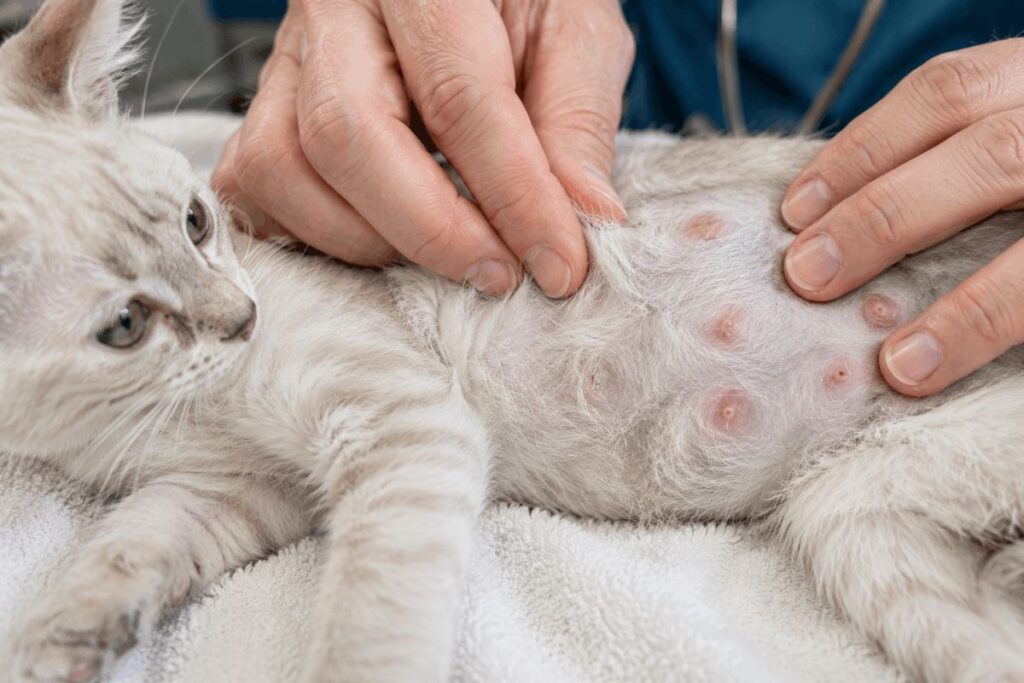
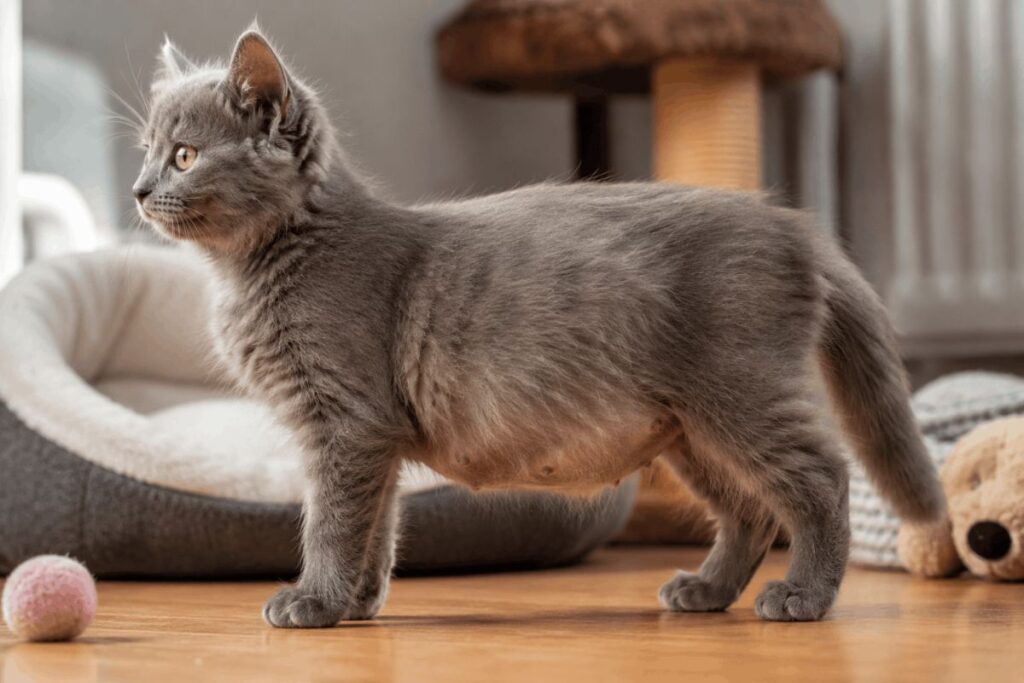
The first visible physical sign of cat’s pregnancy is called “pinking up.” According to PetMD’s veterinary team, this occurs approximately 16 to 20 days into the pregnancy. The nipples become pinker, larger, and more prominent than usual — often the first clue an owner notices before any belly changes appear.
If your kitten has always had tiny, flat nipples barely visible under her fur, and they suddenly appear rosy and slightly swollen, this is a significant indicator. Some nipples may also produce a small amount of discharge as pregnancy progresses. As long as the discharge is not blood-tinged or foul-smelling, this is normal.
2. Swollen, Rounded Belly
A cat’s abdomen will not become noticeably larger until approximately week 5 of the 9-week pregnancy. According to Dr. Angela Beal, DVM, writing for CareCredit, a pregnant cat will gain a total of two to four pounds overall, depending on the number of kittens. The weight centers around the abdomen. If your kitten appears overweight specifically in the belly area while her legs and face remain slender, this pattern is characteristic of pregnancy.
3. Feeling Kittens Move
Around the midpoint of the pregnancy (week 4 to 5), you may be able to gently feel kittens moving when you place your hand on the belly. CareCredit’s veterinary guide notes this as one of the eight signs. Do not press firmly or squeeze — gentle contact only.
4. Heat Cycle Stops Suddenly
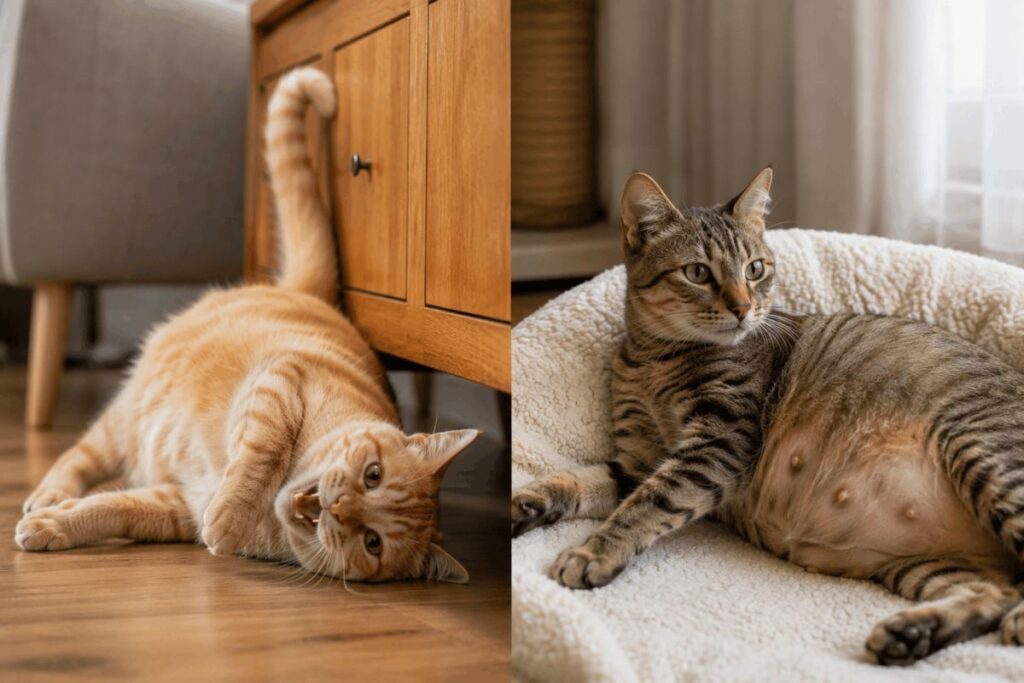
If you have been monitoring your kitten’s heat cycles (the loud yowling, the restlessness, the rolling behavior), and the cycle stops abruptly, this is one of the clearest behavioral indicators that she has become pregnant. Whisker.com’s veterinary team confirms: “If the heat cycle suddenly stops, your cat is likely pregnant.”
Behavioral Signs — Changes in Personality and Habits
5. Increased Affection and Clinginess
Hormonal changes during pregnancy cause many cats to become noticeably more affectionate than usual. Your kitten may seek your lap, follow you more than before, and purr more frequently. This behavioral shift can be one of the easier changes to notice — especially in cats who are normally independent.
6. Increased Appetite
Pregnant cats eat significantly more than usual — San Jose Vets notes that pregnant cats may eat as much as 25% more than normal to nourish their developing kittens. If your kitten seems perpetually hungry, is finishing her bowl faster than usual, and looking for more immediately after, this is a meaningful sign.
7. More Sleep Than Usual
Pregnancy is physically demanding. Your kitten’s body is working overtime to develop kittens while still growing herself. Sleeping more than usual is a normal response. If she was previously energetic and playful and has become notably more restful — combined with other signs — this is worth noting.
8. Nesting Behavior
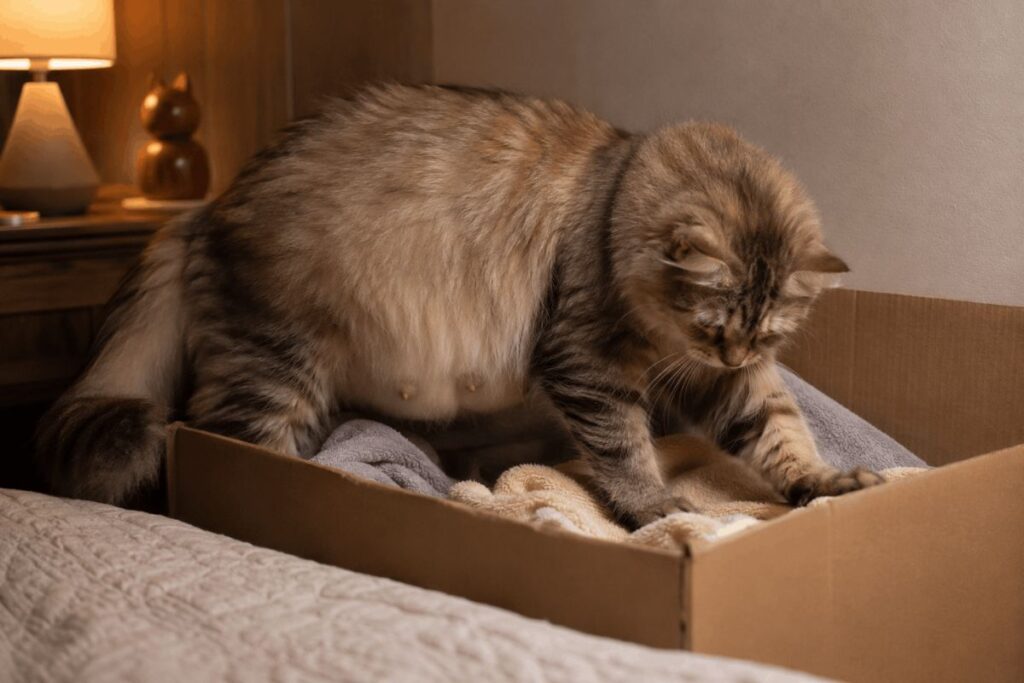
In the final two to three weeks of pregnancy, most cats display nesting behavior. They seek quiet, secluded spots — under beds, in closets, in the back of wardrobes. They may gather soft materials: blankets, clothing, and towels. If your kitten starts creating a small nest in a hidden corner, birth is approaching within weeks.
Week-by-Week Sign Timeline — When Each Sign Appears
This table is what no competitor provides — a clear timeline of when to look for each sign.
| Week | Days | Signs to Look For |
| Week 1 | Days 1–7 | No visible signs — fertilization occurring |
| Week 2 | Days 8–14 | No visible signs — implantation happening |
| Week 3 | Days 15–21 | Pinking up begins — nipples become pinker and larger |
| Week 3–4 | Days 16–28 | Possible mild morning sickness — occasional vomiting |
| Week 3–4 | Days 20–28 | Increased affection, clinginess, more sleep |
| Week 4 | Days 25–30 | Subtle belly rounding begins — hard to see yet |
| Week 5 | Days 30–35 | Belly clearly larger — heat cycles stopped |
| Week 5–6 | Days 35–42 | Kitten movement may be felt gently |
| Week 6–7 | Days 42–49 | Nipples swollen, possible discharge |
| Week 7–8 | Days 49–56 | Belly large and prominent — appetite at peak |
| Week 8–9 | Days 56–63 | Nesting behavior begins — birth imminent |
How to Tell if a Kitten Is Pregnant or Just in Heat
This is one of the most common sources of confusion for kitten owners. Heat cycles and early pregnancy can look similar — increased affection, changed behavior, restlessness. But they are completely different situations requiring completely different responses.
Pregnant vs In Heat vs False Pregnancy — Side by Side
| Feature | In Heat (Estrus) | Pregnant | False Pregnancy |
| Duration | 3–20 days, repeats every 3 weeks | 63–65 days (one-time) | 1–3 weeks, resolves naturally |
| Nipple changes | Minimal | Significant pinking up at ~3 weeks | Possible swelling |
| Vocalization | Loud yowling, constant calling | Quieter than heat | Usually quiet |
| Belly swelling | None | Visible from week 5 | Possible mild swelling |
| Appetite | May decrease | Increases significantly (+25%) | Variable |
| Nesting | None | Strong in final 2–3 weeks | Possible mild nesting |
| Affection seeking | Strong | Moderate increase | Variable |
| Rolling and posturing | Yes — constant | No | No |
| Confirmed by vet | Observation only | Ultrasound / palpation / X-ray | Ultrasound rules out pregnancy |
The clearest distinguishing factor: a cat in heat yowls loudly and rolls on the floor in an almost theatrical way. A pregnant cat becomes quieter and more settled. The transition from loud, heated behavior to calm, quiet is often the moment owners realize pregnancy may have occurred.
What Is Pseudopregnancy (False Pregnancy) in Cats
False pregnancy — also called pseudopregnancy or phantom pregnancy — is a condition where a cat’s body displays pregnancy symptoms without an actual pregnancy. PetMD explains that this occurs because cats are induced ovulators — their bodies release eggs in response to mating. If mating occurs but fertilization does not, the resulting hormonal changes (shifts in progesterone and prolactin) can mimic pregnancy.
A pseudopregnant cat may show pinking up, mild belly swelling, and even mammary development or milk production — without carrying any kittens. This is why a vet visit is essential to confirm whether your kitten is truly pregnant or experiencing a false pregnancy. The two conditions look similar and cannot be reliably distinguished at home.
False pregnancy typically resolves without treatment within 1 to 3 weeks. It does not affect future fertility.
How to Confirm Kitten Pregnancy at the Vet
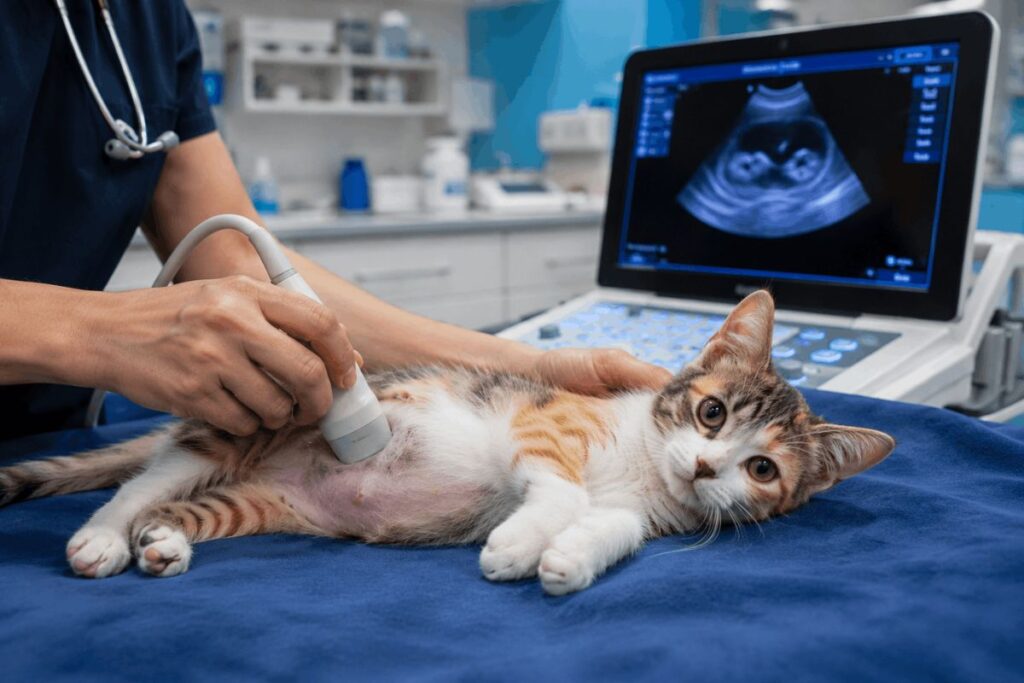
There is no reliable home pregnancy test for cats. Confirming a kitten pregnancy requires a veterinarian — and the sooner you go, the more information you will have. The recommended window for a first appointment is around day 21 if you suspect pregnancy, according to WoPet’s veterinary contributors.
Palpation, Ultrasound, and X-Ray — What Each Test Reveals
| Method | When It Works | What It Reveals | Notes |
| Palpation (belly feel) | Days 17–25 | Small grape-like embryo swellings | Must be done by vet — not at home |
| Ultrasound | From day 15 | Fetal heartbeats, viability confirmation | Most accurate — does not give exact kitten count |
| Blood test (relaxin hormone) | Day 25–30 | Confirms pregnancy via hormone levels | Less commonly used — ultrasound preferred |
| X-ray / radiograph | Day 42+ | Exact kitten count, skeletal development | Safe for developing kittens — one X-ray exposure |
Southborough Vet clarifies the X-ray concern many owners have: “The amount of radiation is pretty small — one X-ray is generally considered safe for developing kittens.” An X-ray after day 42 is the only way to get an accurate count of how many kittens to expect — critical information for preparing for the birth.
Do not attempt to palpate your kitten’s belly at home. Pressing on the abdomen of a pregnant cat can cause pain and, in worst cases, may lead to miscarriage.
The Real Owner Story — The “Heat Cycle” That Was Actually a Litter
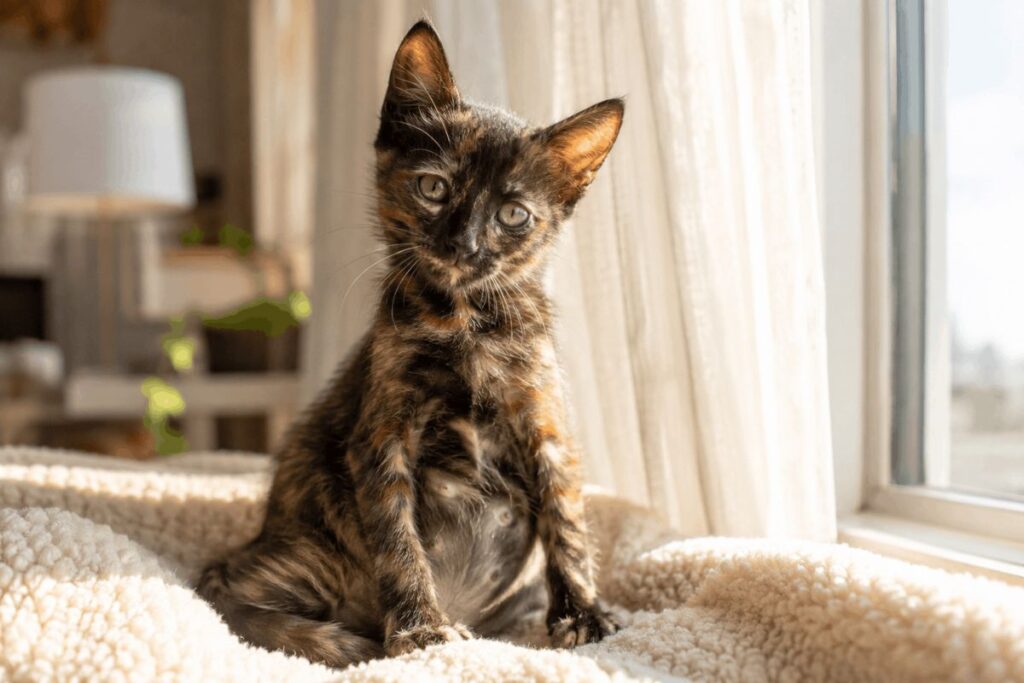
Emma from Nashville adopted a five-month-old tortoiseshell kitten named Clover in November 2024. In January, Clover started yowling loudly, rolling on the floor, and seeking attention constantly. Emma had never owned a cat before. She researched online, concluded this was a heat cycle, and waited for it to pass.
The yowling stopped after about a week. Emma felt relieved. Six weeks later, she came home from work to find five newborn kittens in her closet.
Her vet told her at the post-birth visit that what she had observed in January was indeed a heat cycle — but Clover had gotten outside briefly during that period and had mated. The pregnancy had been entirely invisible to Emma because she did not know what pinking up looked like, and Clover’s dark tortoiseshell coat had hidden the belly changes until nearly the end.
“I had no idea she could even get pregnant at five months,” Emma said. “I thought she was too young.”
Clover and all five kittens were healthy. But Emma’s vet scheduled all five kittens for spay and neuter appointments immediately — and spayed Clover as soon as she finished nursing.
How to Care for a Pregnant Kitten
If your vet has confirmed that your kitten is pregnant, the care plan is straightforward — but it needs to start immediately. A pregnant kitten has higher nutritional and environmental needs than a normal adult cat pregnancy.
Feeding a Pregnant Kitten — What She Actually Needs
Switch your pregnant kitten to high-quality kitten food immediately — not adult cat food. PetMD recommends a diet labeled for “pregnancy and lactation” or for “growth” (kitten food). Royal Canin Mother & Baby Cat is one of the most widely recommended brands specifically for this life stage.
Kitten food provides:
- Higher protein (30%+ dry matter) to support both her growth and fetal development
- Higher calorie density for increased energy demands
- DHA for brain and eye development in the unborn kittens
- Calcium for bone formation
Feed multiple small meals throughout the day rather than one or two large ones. As the pregnancy progresses and kittens take up more space in the abdomen, your kitten will physically be unable to eat large portions — smaller, more frequent meals become essential.
Do not add supplements without veterinary guidance. Most quality kitten foods are nutritionally complete. Over-supplementing calcium during pregnancy can cause hypocalcemia (milk fever) after birth.
Creating a Safe Nesting Space Before the Birth
Around week 7 to 8 of the pregnancy, your kitten will begin looking for a nesting spot. If you want control over where she gives birth, set up a nesting box before she chooses one herself — because once a queen has chosen her spot, moving her causes significant stress.
An ideal nesting area:
- Lined cardboard box or covered cat bed with low sides for easy entry
- Soft blankets or clean old towels lining the interior
- Located in a quiet, warm, low-traffic area of the home
- Away from children, other pets, and frequent household noise
- Large enough for the mother to stretch out fully
Show your kitten the nesting box early. Place a worn item of your clothing inside — the familiar scent helps her feel safe in the new space.
Emergency Signs That Require Immediate Vet Care
Most cat births proceed without intervention. But certain signs during labor require immediate emergency veterinary care — do not wait.
| Emergency Sign | What It May Indicate | Action |
| Straining 30+ minutes without producing a kitten | Kitten obstruction in birth canal | Emergency vet — immediately |
| Severe continuous bleeding | Internal hemorrhage | Emergency vet — immediately |
| Collapse or inability to stand | Shock or eclampsia | Emergency vet — immediately |
| Green/black discharge before first kitten | Placental separation without delivery | Emergency vet — immediately |
| Labor stopped with kittens still inside | Uterine inertia | Emergency vet — call first |
| Previously felt kittens moving but no longer do | Possible fetal distress | Emergency vet — same day |
| Kitten stuck in birth canal for 10+ minutes | Dystocia | Emergency vet — immediately |
Keep your vet’s emergency number saved before the due date. Births often happen at night. Know where the nearest 24-hour emergency veterinary clinic is before the kittens arrive.
Final Thought
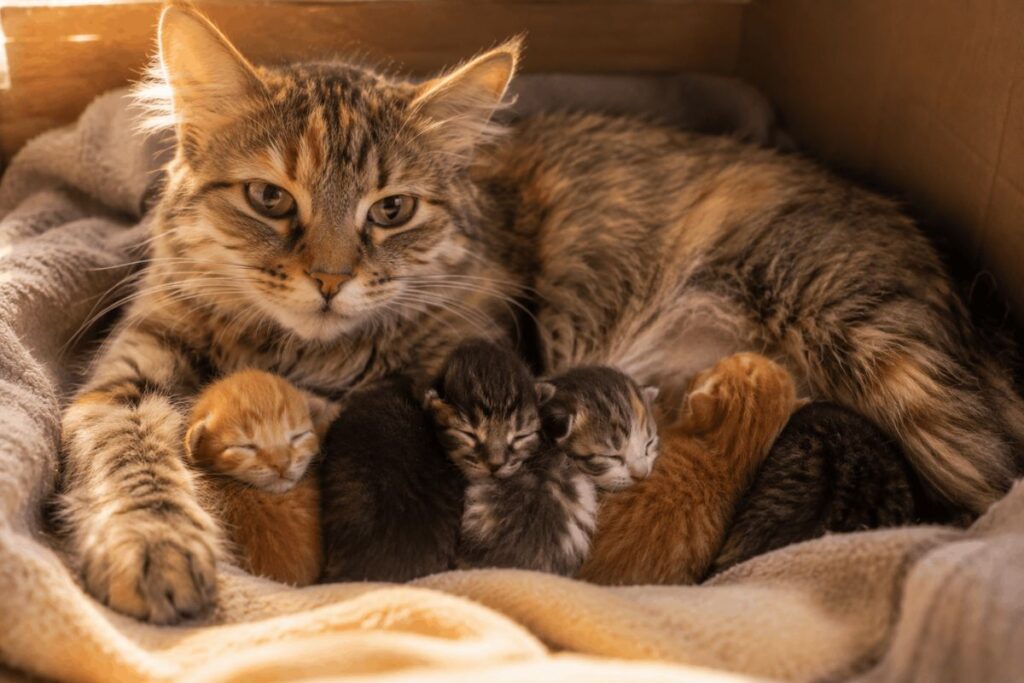
Knowing how to tell if your kitten is pregnant is the first step — but acting on what you discover is what matters. A pregnant kitten is not a situation to observe from a distance, and hope resolves itself. She needs veterinary confirmation, nutritional support, and a safe environment — ideally within days of your suspicion, not weeks.
The earliest sign is pinking up of the nipples at around 16 to 20 days. The clearest sign is a belly that is visibly rounder by week 5. If you see both together, call your vet today.
And once this pregnancy is safely through, please spay her. A kitten who has just raised one litter still has years of reproductive potential ahead of her. Give her the chance just to be a cat.
Frequently Asked Questions
How early can you tell if a cat is pregnant?
Pregnancy signs usually appear after 2–3 weeks. Vets can confirm it earlier with an ultrasound.
What are the first signs of a pregnant cat?
Pink, enlarged nipples, increased affection, more sleep, and a bigger appetite are common early signs.
Can a kitten get pregnant at 4 months old?
Yes. Female kittens can become pregnant as early as 4 months if unspayed.
How long is a cat pregnant before showing?
Most cats start visibly showing around week 5 of their 9-week pregnancy.
What does pinking up look like in a pregnant cat?
The nipples become brighter pink, slightly swollen, and more noticeable than usual.

Wahsay Ahmed is the founder of FelineNest and a cat care writer. His interest in feline health began in 2023 after adopting two cats, Whisker and Mochi. Since then, he has spent two years studying trusted veterinary resources, feline behavior, nutrition, and preventive care while applying that knowledge through daily care of his own cats.