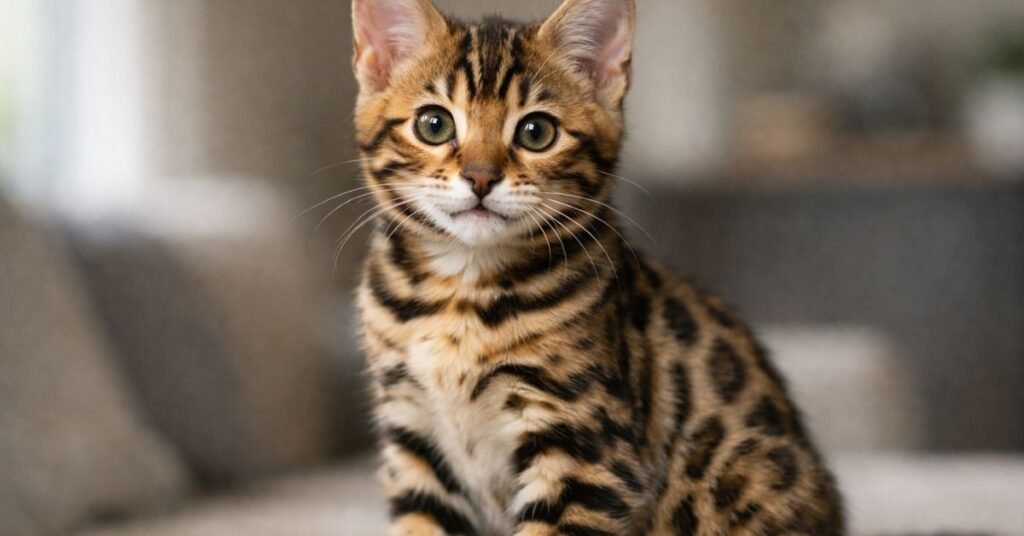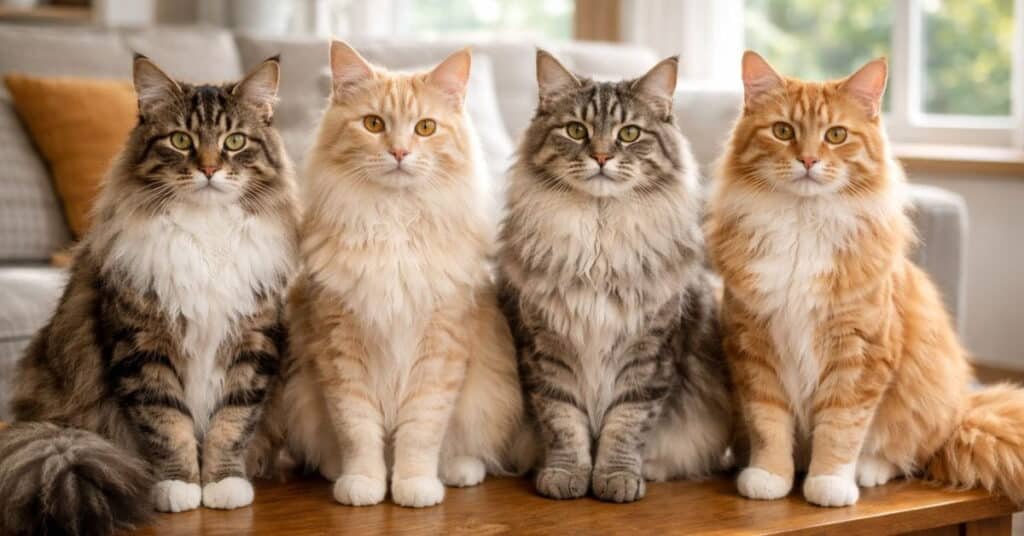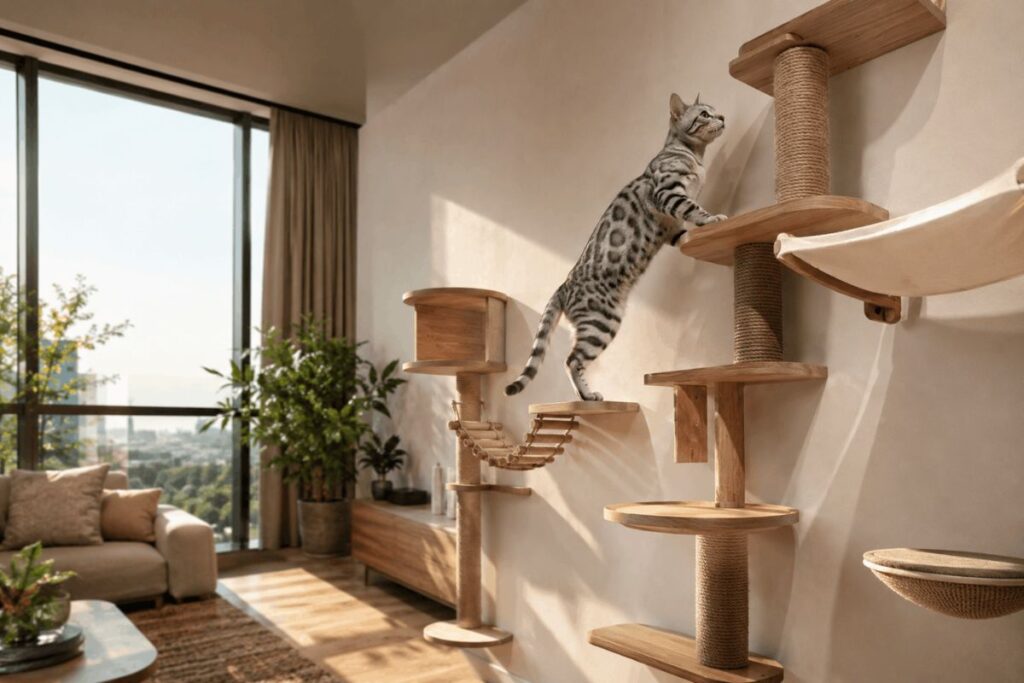
A wall cat tree is a cat climbing system mounted directly onto your wall — as opposed to a freestanding floor-standing cat tree. Instead of taking up square footage, it uses the vertical wall space you already have. The structure typically includes a combination of platforms (flat perches for sitting), hammocks (suspended resting areas), bridges (horizontal pathways between platforms), and scratching surfaces (sisal-wrapped posts or panels).
According to Catastrophic Creations — one of the most established USA wall cat furniture brands — wall-mounted systems exist to solve one specific problem: “Living in a small home or apartment can be crowded enough, without adding bulky cat trees and towers to the mix. So how do you enrich your cat’s life without sacrificing your own comfort? You build up instead.”
The Science Behind Why Cats Need Vertical Territory
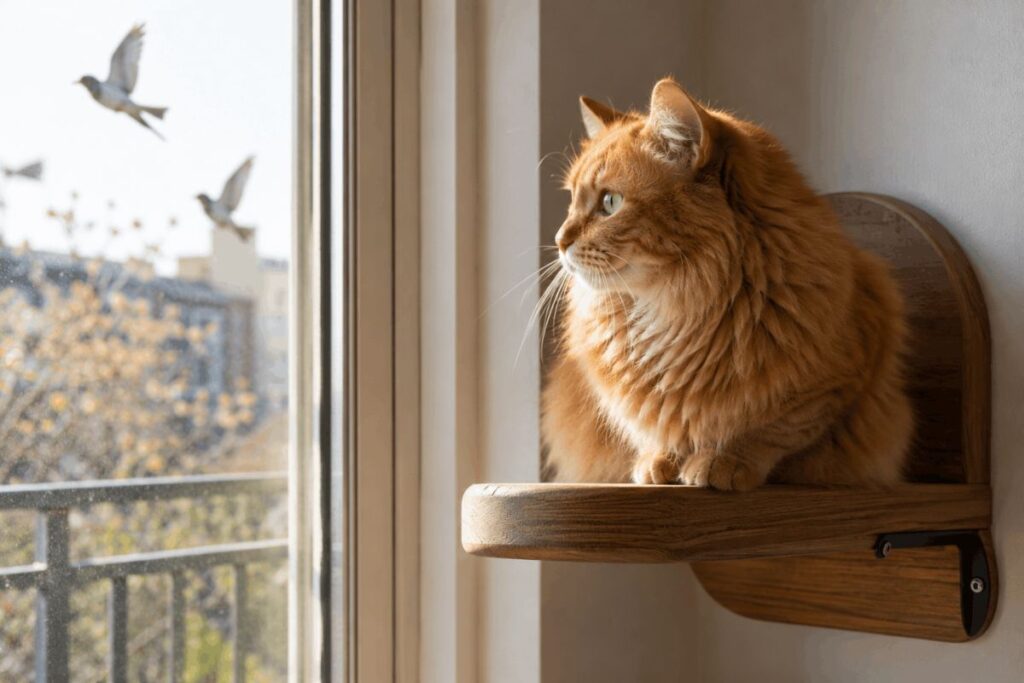
The reason cats obsessively seek height is not stubbornness — it is survival programming. Catastrophic Creations’ team explains it simply: “Cats are natural predators, but your cat is also prey. Being high up gives your cat a better vantage point to survey potential danger and food sources. This allows your cat to feel more secure in his home, as he can determine the threat level of unknown visitors, dogs, or even small children while remaining safely out of reach.”
This is why a cat who has access to adequate vertical territory is calmer, less territorial toward other pets, less destructive toward furniture, and less prone to stress-related behaviors. A wall cat tree is not a luxury. It is an environmental necessity for a genuinely happy indoor cat — particularly in apartments where floor space is limited, and the cat has nowhere to go but horizontally.
Wall Cat Tree vs Regular Cat Tree — Honest Comparison
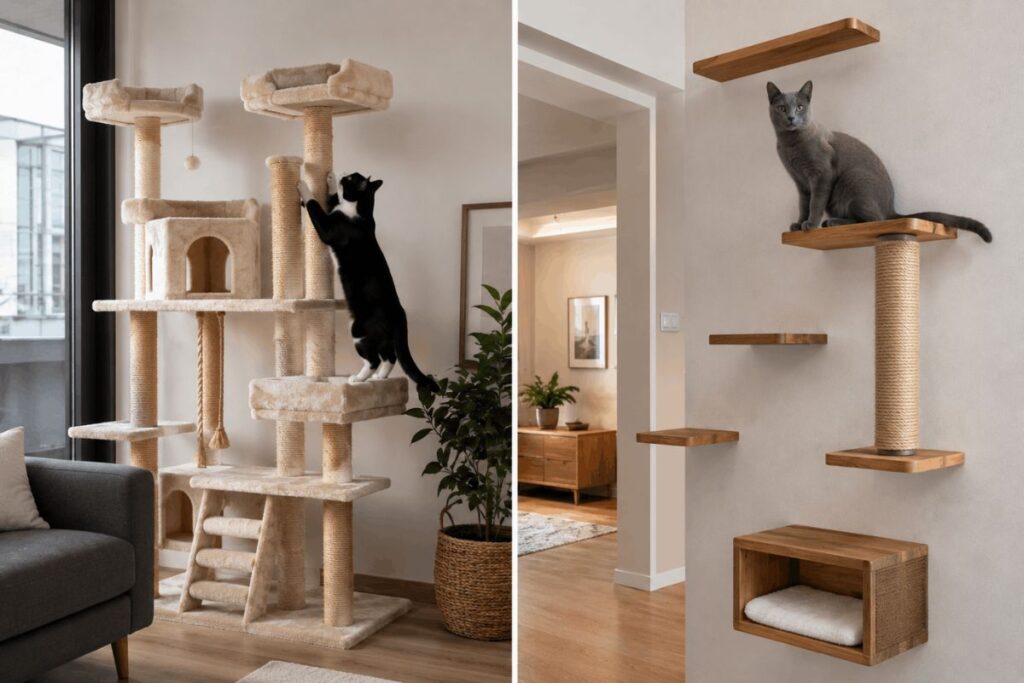
This is the table no competitor includes — and it makes the buying decision clear.
| Feature | Wall Cat Tree | Regular Floor Cat Tree |
| Floor space required | Zero — wall mounted | Significant — 20×20 inches minimum |
| Stability | Extremely stable — anchored to wall | Variable — can tip with active cats |
| Installation | Requires drill + 60-90 minutes | No tools — flat pack assembly |
| Suitable for renters | Yes — with small hole repair | Yes — no wall modification |
| Customizable | Highly — modular systems expand | Limited by purchased configuration |
| Aesthetic | Integrates into décor | Often clashes with décor |
| Weight capacity | 40–85 lbs per mounting point | Varies — often less stable for large cats |
| Best for small spaces | ✅ Ideal | ❌ Takes significant floor area |
| Best for renters | ✅ With planning | ✅ Easiest option |
| Best for large cats | ✅ When properly mounted | ⚠️ Needs wide, heavy base |
| Cost range | $50–$700+ | $30–$500+ |
| Durability | High — wall anchors mean no tipping | Moderate — base can loosen over time |
RshPets summarizes the key trade-off cleanly: “If you’re in a small space, plan to stay put, have a large or active cat, or care about how your home looks — a wall system will serve you better in almost every way. The setup investment pays back in floor space, durability, and a happier cat.”
Is a Wall Cat Tree Right for Your Home?
Wall cat trees work for most homes — but three specific situations affect the decision significantly: renting, large cats, and multiple cats. Here is an honest assessment of each.
Wall Cat Trees for Renters — What You Need to Know
The number one concern renters have about wall cat trees is the security deposit. Catastrophic Creations directly addresses this: “We have heard concerns about getting the security deposit back, but from my experience living in many rented spaces, I have never had money held back due to wall damage. Apartments allow people to hang pictures, and our furniture is installed with #8 wood screws, which are the same size as a typical screw used for hanging.”
The practical reality: a wall cat tree leaves small screw holes that can be filled with standard spackle and touched up with matching paint before move-out. This is the same process required after removing any wall art or shelving. The holes are smaller than what a towel rack or curtain rod leaves.
| Renter Scenario | Wall Cat Tree | Floor Cat Tree |
| Short lease (under 6 months) | ❌ Not worth it — wait | ✅ Best option |
| Long lease (1+ years) | ✅ Worth it — save floor space | ✅ Both work |
| Strict no-drill lease | ❌ Check lease terms first | ✅ Best option |
| Standard lease (picture-hanging allowed) | ✅ Fine — patch holes at move-out | ✅ Both work |
| Own your home | ✅ Ideal — no limitations | ✅ Both work |
RshPets offers the most practical renter guidance: “Renters who can’t drill: cat tree. Renters who don’t mind filling small holes later — or homeowners: a wall system is worth it.”
Wall Cat Trees for Large Cats — Size and Weight Capacity Guide
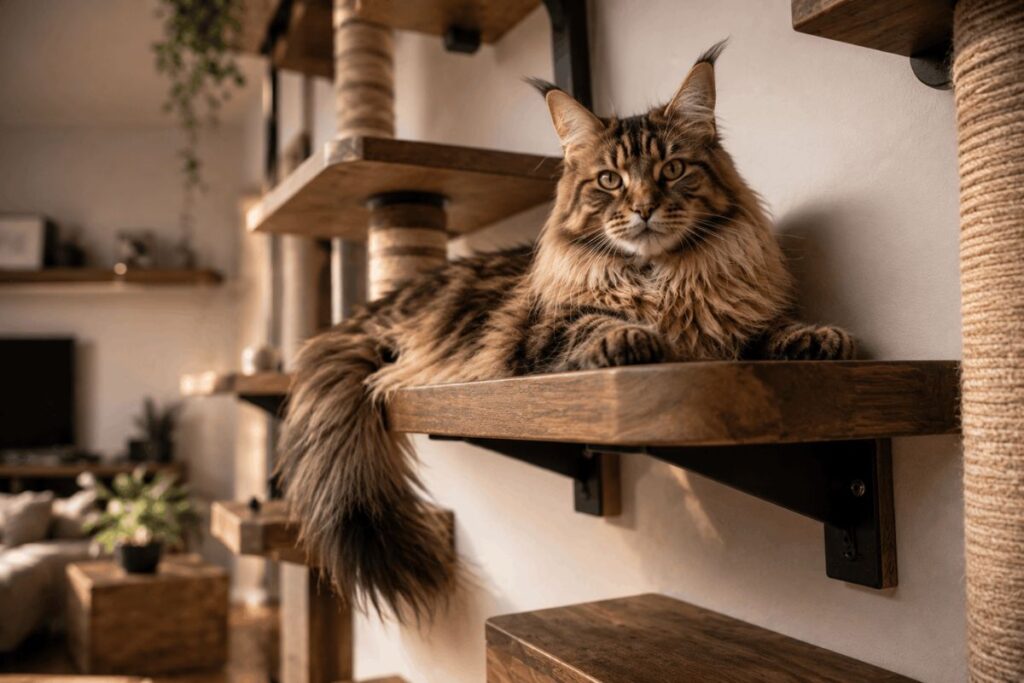
Standard wall cat shelves are designed for average domestic cats (8-12 lbs). For large breeds — Maine Coons, Norwegian Forest Cats, Ragdolls, and British Shorthairs over 15 lbs — weight capacity and platform width become critical safety factors.
| Cat Size | Weight | Minimum Platform Width | Minimum Load Capacity | Recommended System |
| Small cat / kitten | Under 8 lbs | 10–12 inches | 20 lbs | Any standard system |
| Average adult | 8–12 lbs | 12–14 inches | 30 lbs | Most systems qualify |
| Large adult | 12–16 lbs | 14–16 inches | 40 lbs | VEVOR (40 lbs), COZIWOW |
| Giant breed | 16+ lbs | 16–20 inches | 60+ lbs | Catastrophic Creations (85 lbs) |
The Catastrophic Creations Juggernaut is specifically engineered for large cats — its bamboo construction holds 85 lbs per mounting point, making it the safest option for Maine Coons and similarly large breeds.
Wall Cat Trees for Multiple Cats — Territory and Space Planning
Multiple cats need multiple pathways. The biggest mistake multi-cat owners make with wall systems is buying a linear single-route design, which creates bottlenecks where cats block each other and trigger territorial conflict.
For multi-cat homes, look for systems with:
- Multiple entry and exit points — cats should be able to approach platforms from at least two directions
- Enough platforms for each cat plus one — if you have 3 cats, install 4 perches minimum
- Varied heights — higher perches for dominant cats, lower perches for submissive cats
- Hammocks and enclosed spaces — shy cats need retreat options alongside open platforms
8 Best Wall Cat Trees in 2026
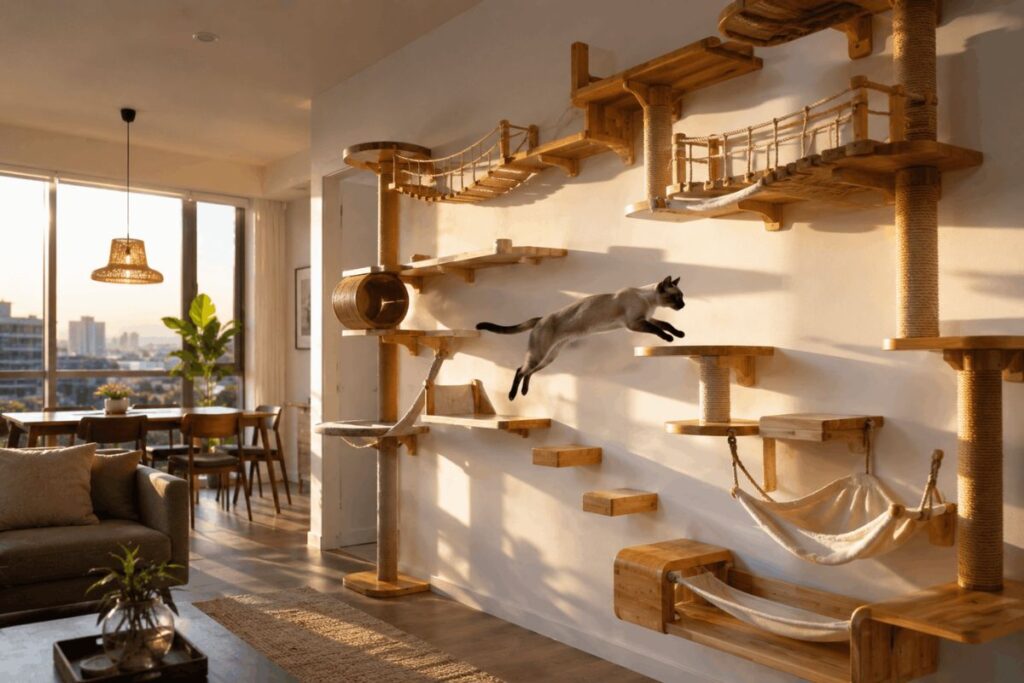
Here is the full comparison before we go into detail:
| Product | Load Capacity | Material | Best For | Price Range |
| Catastrophic Creations Juggernaut | 85 lbs/point | Sustainable bamboo | Best overall, large cats | $300–$700 |
| VEVOR 6-Piece Wall Cat Set | 40 lbs | Particle board + metal | Best budget | $80–$130 |
| COZIWOW 5-Piece Wall Furniture | 35 lbs | MDF + plush | Best for apartments | $70–$110 |
| The Refined Feline Lotus Leaf | 85 lbs | Bent plywood/steel | Best premium | $90–$180/shelf |
| IKEA Lack Shelf (DIY) | 25 lbs | MDF | Best DIY budget | $10–$50 |
| PawHut 7-Tier Wall Climber | 35 lbs | Wood + sisal | Best multi-feature | $90–$140 |
| VEVOR Premium Cat Wall Set | 40 lbs | Pine + metal frame | Best mid-range | $100–$160 |
| Wayfair 7-Tier Wall Set | 35 lbs | Wood + sisal rope | Best aesthetic variety | $120–$200 |
Best Overall — Catastrophic Creations Juggernaut
Catastrophic Creations has been building wall-mounted cat furniture for over a decade — and the Juggernaut is their most comprehensive system. Spanning 89 inches wide and 63 inches tall, it includes multiple hammocks, a full scratching pole, and a bridge connecting both sides. Bamboo construction holds 85 lbs per mounting point — the highest capacity in this category.
The Juggernaut is designed for homes with multiple cats or large breeds — specifically cited by Catastrophic Creations for Maine Coons and similarly large cats. It requires mounting into 6 studs at 16-inch on-center spacing, which makes installation more involved but significantly more secure than systems using drywall anchors. Reviewers consistently note that installation takes 2 to 3 hours but produces a system that “feels like part of the house.” Price: $300–$700 depending on configuration. Available at catastrophicreations.com.
Best Budget — VEVOR Wall-Mounted Cat Shelves Set
With over 40,000 positive Amazon reviews, the VEVOR 6-piece wall cat system delivers genuine value at a budget price. The set includes 2 jumping boards, 1 hammock, 1 sofa platform, 1 small cat tree section, and 1 grip platform — covering climbing, resting, and scratching needs in a single purchase.
Made from particle board and a metal frame, it supports up to 40 lbs — appropriate for most domestic cat breeds under 15 lbs. The plush-covered surfaces prevent paw slipping during active use. Installation takes approximately 60 to 90 minutes and requires an 8mm drill bit. VEVOR includes all necessary hardware. At $80 to $130, this is the most accessible entry point into wall cat systems. Available at Amazon, Wayfair, and Home Depot.
Best for Apartments — COZIWOW 5-Piece Wall Cat Furniture
COZIWOW’s 5-piece wall cat furniture is the best option for small apartments where both floor space and wall space are limited. The compact, modular design allows positioning in tight spaces — including narrow walls between windows, above desks, or along hallways.
Available in grey, black, beige, and colorful options, it blends into apartment interiors better than most budget alternatives. The compact platform sizes — appropriate for cats under 12 lbs — mean it is not ideal for large breeds, but for average domestic cats in studio or one-bedroom apartments, it is the most practical entry point. Price: $70–$110. Available at Amazon and Chewy.
Best Premium — The Refined Feline Lotus Leaf Wall Shelves
The Refined Feline builds wall cat shelves for owners who care as much about home aesthetics as feline enrichment. Their Lotus Leaf design — a curved bent plywood shelf with multiple fabric cover options, including Berber carpet, faux sheepskin, and faux white fur — looks like intentional interior design rather than cat furniture.
Construction uses thick bent plywood or steel for a wide platform stability, with pre-drilled holes at 16-inch spacing for stud mounting. All covers are removable and washable. Individual shelves hold 85 lbs. Mix and match with their other designs (climbing ramps, corner shelves, bridge pieces) to build a custom wall system. Price: $90–$180 per individual shelf. Available at therefinedfeline.com.
Best DIY-Friendly — IKEA Lack Shelf Cat Wall System
The IKEA Lack shelf cat wall hack is one of the most popular DIY approaches in the USA cat owner community. IKEA’s Lack shelf ($12 each) is a floating wall shelf that can be staggered at varying heights to create a simple climbing system. Adding non-slip carpet tape or adhesive sisal to the top surface provides traction for cats.
The main limitation is load capacity — Lack shelves hold approximately 25 lbs under typical mounting conditions, which is adequate for most domestic cats but not for large breeds. The other limitation is aesthetics — a standard Lack shelf looks like an IKEA shelf, not dedicated cat furniture. For owners who want to test wall cat systems before committing to a premium brand, the DIY Lack shelf approach costs $50 to $100 for a 4 to 6-shelf system. Available at IKEA stores and IKEA.com.
How to Install a Wall Cat Tree — Step by Step
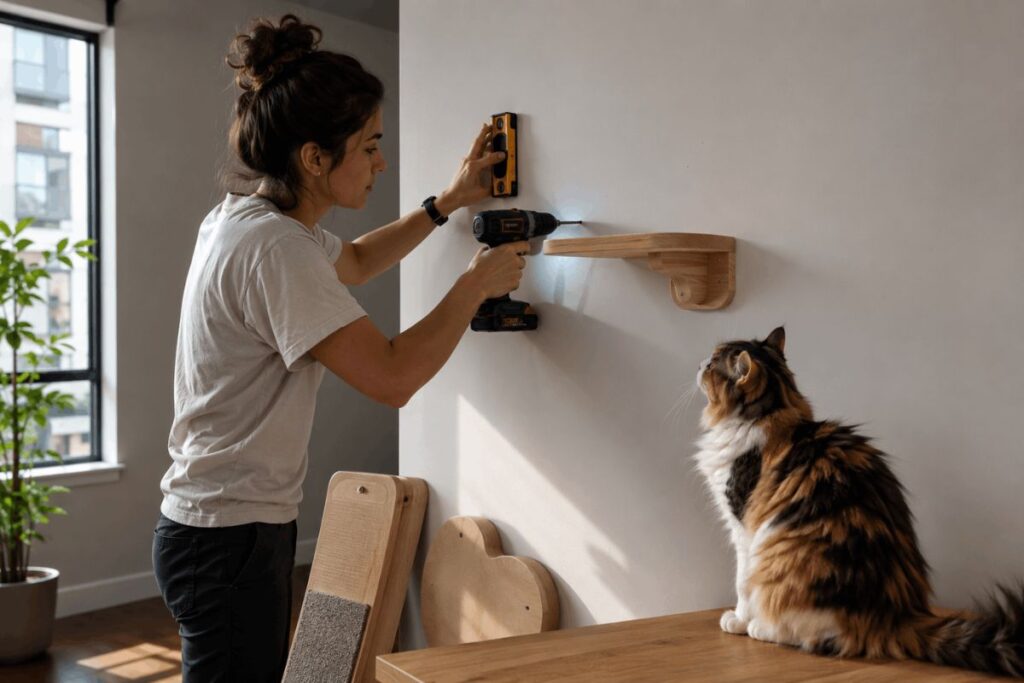
Most owners describe wall cat tree installation anxiety as the biggest barrier to purchase — and consistently describe the actual installation as “easier than expected.” RshPets notes: “If you can hang a picture frame, you can install a cat shelf. The hardest part is deciding where you want it.”
Tools needed: Stud finder, pencil, level, drill, appropriate drill bit (usually 8mm), screwdriver, and the hardware included with your system.
Step 1 — Find your studs. Use an electronic stud finder along the planned installation area. Mark each stud location with a pencil or blue painter’s tape. Standard US wall stud spacing is 16 inches on center. Some older homes use 24-inch spacing — check before purchasing a system that specifies stud spacing requirements.
Step 2 — Plan your layout. Lay the platforms on the floor in the pattern you intend to mount them. Confirm the spacing between levels allows your cat to jump comfortably — most cats jump 18 to 24 inches vertically without difficulty; 12 inches is the minimum comfortable spacing.
Step 3 — Mark your mounting points. Hold each platform against the wall at the correct height and mark the screw hole locations in pencil. Use a level to confirm horizontal platforms are not tilted.
Step 4 — Drill and mount. Drill pilot holes at the marked locations. Insert mounting hardware (screws directly into studs, or anchors in drywall sections). Mount each platform and check that it does not move when you press down with force equivalent to your cat’s weight.
Step 5 — Test before your cat uses it. Hang your full bodyweight on the system if possible — or press firmly downward with 50 to 100 lbs of force. A properly installed wall cat tree should not shift, flex, or make sounds under this load.
Stud Mounting vs Drywall Anchors — Which Is Safer?
| Factor | Stud Mounting | Drywall Anchors |
| Load capacity | Highest — limited by stud strength | Lower — typically 20-50 lbs per anchor |
| Suitable for large cats | ✅ Yes — recommended | ⚠️ Only for cats under 12 lbs |
| Installation difficulty | Moderate | Easy |
| Flexibility of placement | Limited — must align with studs | Flexible — any location |
| Long-term stability | Excellent | Good if not overloaded |
| Recommended by manufacturers? | ✅ Always preferred | ⚠️ Only when studs not accessible |
Catastrophic Creations is explicit: “For your cat wall to be secure for your feline friend, you need to install your cat shelving into studs, concrete, cement, or brick. Drywall alone will not be able to support the weight of your cat playing on their new jungle gym. Even with the help of drywall anchors, you will need at least one mounting point of the cat shelf to be secured into a solid anchor point like a stud.”
The Real Owner Story — The Wall Cat Tree That Saved the Sofa
Marcus from Seattle had a problem every cat owner knows. His 4-year-old Bengal mix, Thor, was destroying the corner of his leather sofa. Not occasionally — systematically, every evening, to the point where the corner was shredded through to the foam.
Marcus tried everything: scratch deterrent spray, tin foil, sticky tape on the sofa corner. Thor ignored all of it. His vet suggested the real issue: Thor had no appropriate vertical territory in the apartment. The sofa scratching was what behaviorists call “redirected climbing behavior” — Thor was trying to mark height and territory on the only vertical surface he regularly interacted with.
Marcus bought a VEVOR 6-piece wall system for $95 and installed it on the wall beside the sofa in one afternoon. He placed treats on each platform to introduce Thor to the system.
Within 4 days, Thor had stopped scratching the sofa entirely. Within 2 weeks, he was spending 3 to 4 hours per day on the wall system — sleeping in the hammock, watching the window from the highest platform.
“I spent three years fighting the sofa battle,” Marcus said. “The $95 wall tree solved it in four days. I wish I had done it the first week I brought him home.”
The sofa corner was repaired with a leather repair kit for $30. Total cost of the solution: $125.
Personal Experience: Choosing a Cat Tree for a Maine Coon
When I first looked at cat trees for a large cat, I noticed that many models looked strong but had surprisingly small platforms. A larger cat needs enough room to turn, stretch, and jump without making the whole structure wobble. After comparing different designs, I found that a wide base, thick posts, and large resting platforms matter more than height alone. This is why I always recommend checking stability and measurements before choosing a Maine Coon cat tree.
A stable cat tree can provide valuable climbing and enrichment opportunities, but it should always match your cat’s size and activity level. The American Association of Feline Practitioners (AAFP) provides feline-care resources that emphasize creating safe, enriching environments for cats. When setting up a large cat tree, make sure it cannot easily tip and inspect platforms, posts, and connections regularly.
Where to Put a Wall Cat Tree in Your Home
The best location for a wall cat tree is the room your cat already spends the most time in. A wall cat system installed in a room your cat avoids will go unused, and unused wall cat trees are one of the most common complaints from owners who did not place them thoughtfully.
Best Placement by Room — A Quick Guide
| Room | Placement | Why It Works | Watch Out For |
| Living room — near window | Beside or above the window | Bird watching, sunbathing, observing family | Curtains or blinds may block |
| Living room — main wall | Center wall opposite seating | Cat can observe room from above | Keep away from TV vibration |
| Bedroom | Above or beside the headboard | Cats sleep near their owners | Jumping onto bed may disturb sleep |
| Home office | Above the desk | Cat can “supervise” without interfering | Jumping on keyboard risk |
| Hallway | Staggered up the wall | Uses unused long wall space | Narrow walls — check stud spacing |
| Entryway | Beside the front door | Cat greets you, marks territory safely | High traffic — ensure secure mounting |
| Corner | Corner-mounted configurations | Maximizes space in multi-cat homes | Studs less predictable at corners |
Catastrophic Creations offers one practical placement tip for entryways: “Cats love being the first to welcome you home. Placing sisal poles or wall-mounted shelves in an entryway gives them a place to perch, scent-mark on the sisal, and safely observe comings and goings without bolting out the door.”
Final Thought
A wall cat tree is the single most effective environmental upgrade for an indoor cat in a limited space. It does not just give your cat somewhere to climb — it gives her the vertical territory she instinctively needs to feel safe, secure, and in control of her environment.
Start with the VEVOR or COZIWOW system if you want to test wall cat trees at a budget price. Step up to Catastrophic Creations or The Refined Feline if you want premium aesthetics and large-cat capacity. Use stud mounting whenever possible — drywall anchors are fine for small cats but unacceptable for anything over 12 lbs.
Install it in the room your cat already loves. Place a treat on every platform on day one. Watch the counter-surfing, furniture-climbing, and sofa-scratching stop within a week.
Your wall is the most underused vertical space in your home. Give it to your cat.
Frequently Asked Questions
What is a wall cat tree?
A wall cat tree is a climbing system mounted on the wall with shelves, bridges, and scratching areas that saves floor space.
Are wall mounted cat trees safe?
Yes — if installed into wall studs correctly. Poor installation into drywall alone is the main safety risk.
Can renters install a wall cat tree?
Yes. Most systems leave small screw holes that can be patched with spackle before moving out.
How do you install a wall cat tree?
Use a stud finder, drill pilot holes, and mount platforms securely into wall studs using the included hardware.
Wall cat tree vs regular cat tree — which is better?
Wall cat trees save space and look cleaner, while floor trees are easier to set up and move around.
What is the best wall cat tree for large cats?
Catastrophic Creations and The Refined Feline are strong choices for large breeds because of their high weight capacity.

Wahsay Ahmed is the founder of FelineNest and a cat care writer. His interest in feline health began in 2023 after adopting two cats, Whisker and Mochi. Since then, he has spent two years studying trusted veterinary resources, feline behavior, nutrition, and preventive care while applying that knowledge through daily care of his own cats.