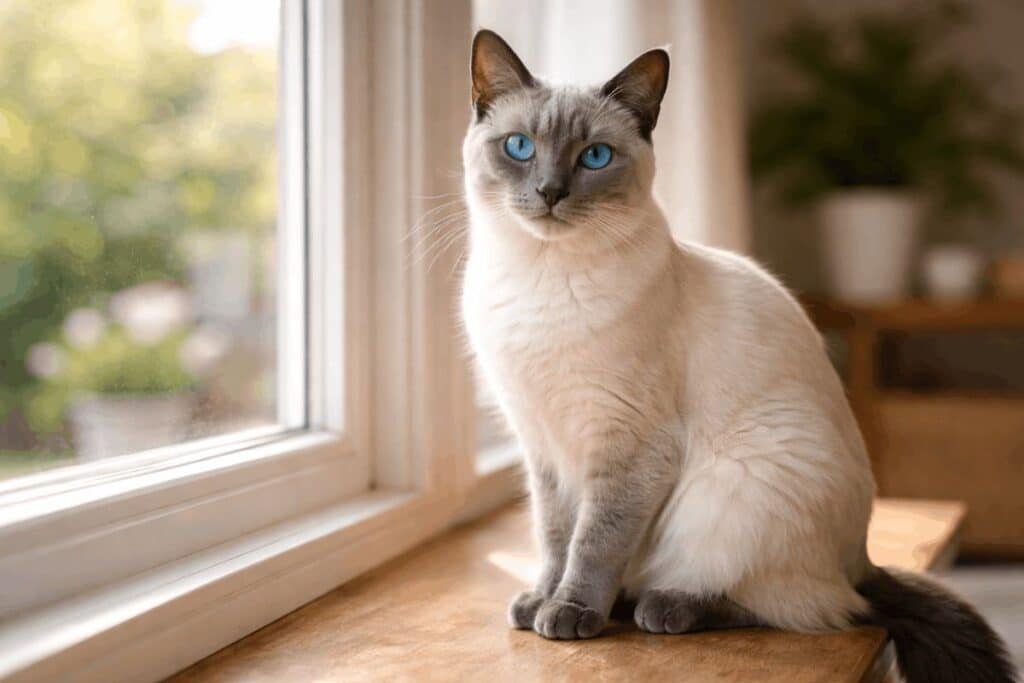
The Blue Point Siamese is one of the most striking and emotionally demanding cat breeds you will ever bring into your home. Their slate-blue points against a glacial white body make them visually unforgettable. Their personality — vocal, intensely loyal, and almost dog-like in attachment — makes them equally unforgettable to live with.
This guide covers everything: appearance, personality, health, care, history, and a complete 2026 price breakdown that no other article gives you.
What Is a Blue Point Siamese Cat?
The Blue Point Siamese is not a separate breed. It is an officially recognized color variation of the Siamese breed, first recognized by the Cat Fanciers’ Association (CFA) in 1934 — making it one of only four officially recognized Siamese colors alongside Seal Point, Chocolate Point, and Lilac Point.
The “blue” in their name does not refer to bright or royal blue. It describes a soft, diluted gray with cool blue undertones — often called slate blue or blue-gray. This color appears on their points: ears, face mask, paws, and tail. Their body remains a pale, glacial bluish-white.
Genetically, the Blue Point is a dilute version of the Seal Point Siamese. The same gene that produces the dark brown of a Seal Point produces the cooler, softer blue-gray of a Blue Point when diluted.
Blue Point Siamese Appearance — Size, Color & Physical Traits
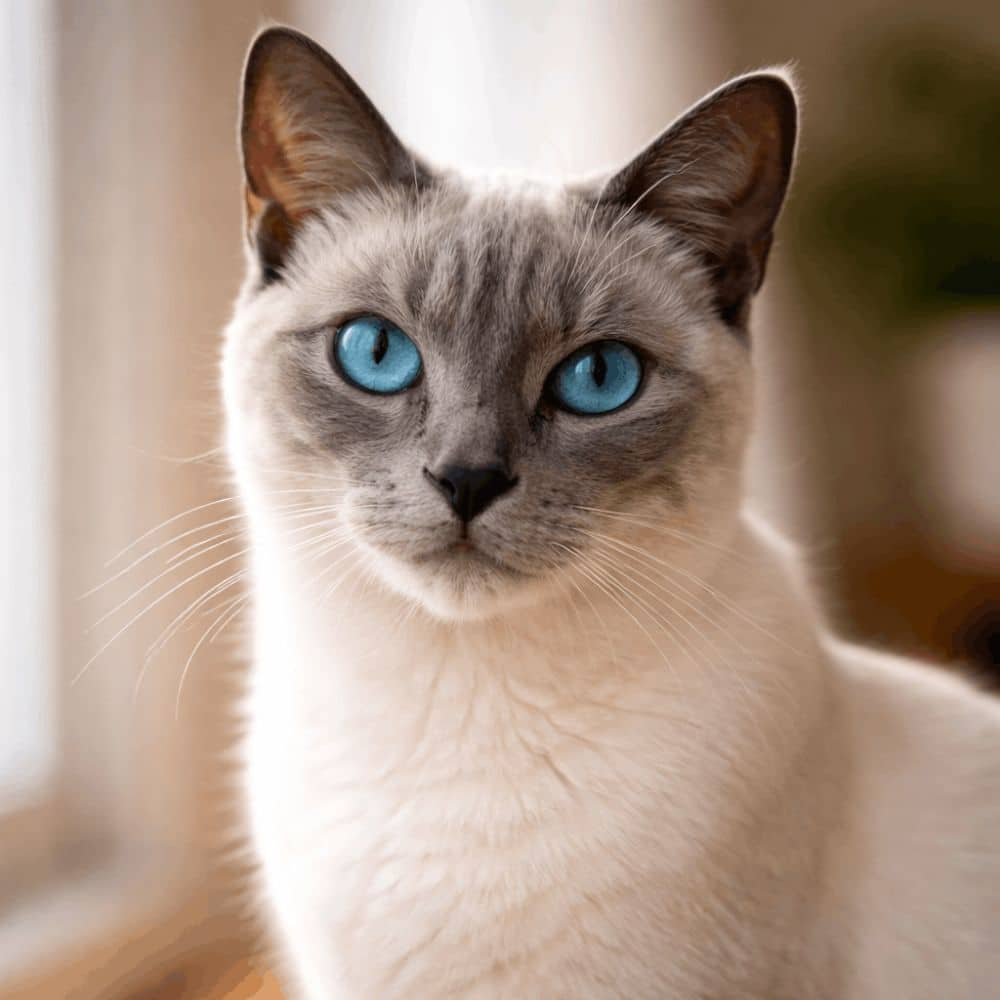
A Blue Point Siamese is immediately recognizable. Here are their physical characteristics in detail:
| Feature | Blue Point Siamese Specification |
|---|---|
| Body type | Slender, muscular, long — classic Siamese wedge shape |
| Weight | 6–12 lbs (males heavier than females) |
| Height | 10–12 inches at shoulder |
| Coat length | Short, fine, silky — lies flat against body |
| Body color | Glacial bluish-white; may darken slightly along spine with age |
| Point color | Dense slate-blue/blue-gray — ears, face, paws, tail |
| Eye color | Vivid, deep sapphire blue — almond-shaped |
| Nose leather | Blue, matching point color |
| Paw pads | Blue |
| Ears | Large, wide-set, pointed — proportionally large for head size |
| Head shape | Wedge-shaped (modern type); slightly rounder in traditional/applehead |
One important detail: a Blue Point Siamese born completely white. The temperature-sensitive enzyme that produces their coloring is not activated in the warmth of the womb. After birth, as body temperature drops in cooler areas (ears, face, paws, tail), the coloring begins to develop — usually showing as early as 1 week old and continuing to deepen through the first two years.
Blue Point vs Seal Point vs Lilac Point: Side-by-Side
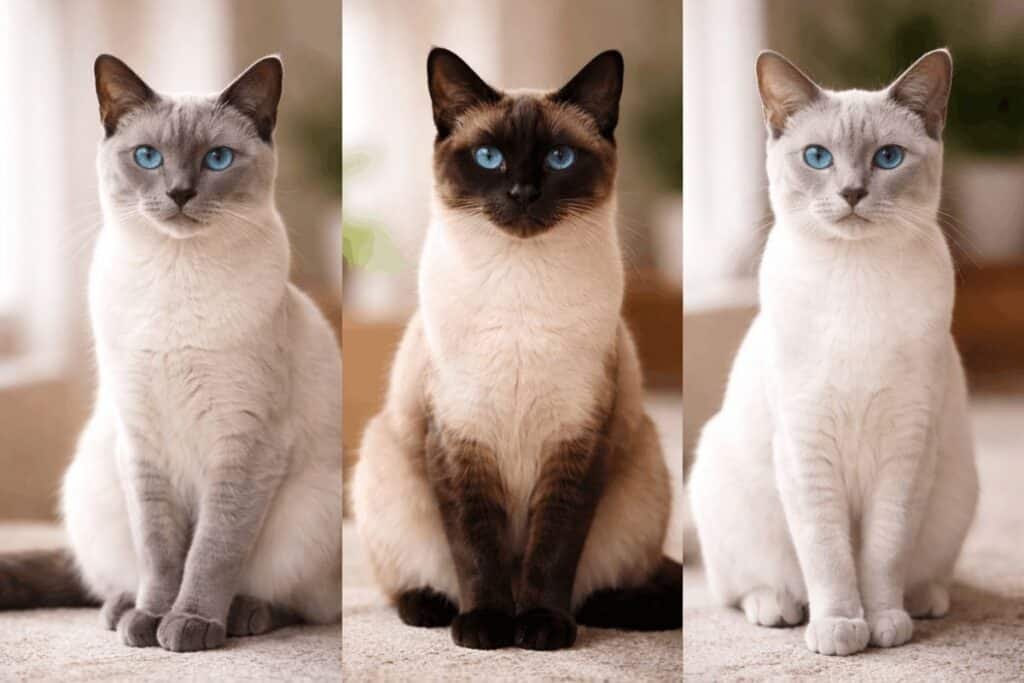
| Feature | Blue Point | Seal Point | Lilac Point |
|---|---|---|---|
| Point color | Slate blue-gray | Dark brown, almost black | Pale pinkish-gray |
| Body color | Glacial bluish-white | Warm cream to fawn | Magnolia white |
| Rarity | Moderate | Most common | Rarest of four |
| CFA recognition | 1934 | Original | 1955 |
| Contrast level | Medium | Highest | Softest |
| Aging effect on coat | Darkens along spine | Darkens significantly | Stays pale lifelong |
Blue Point Siamese Personality & Behavior
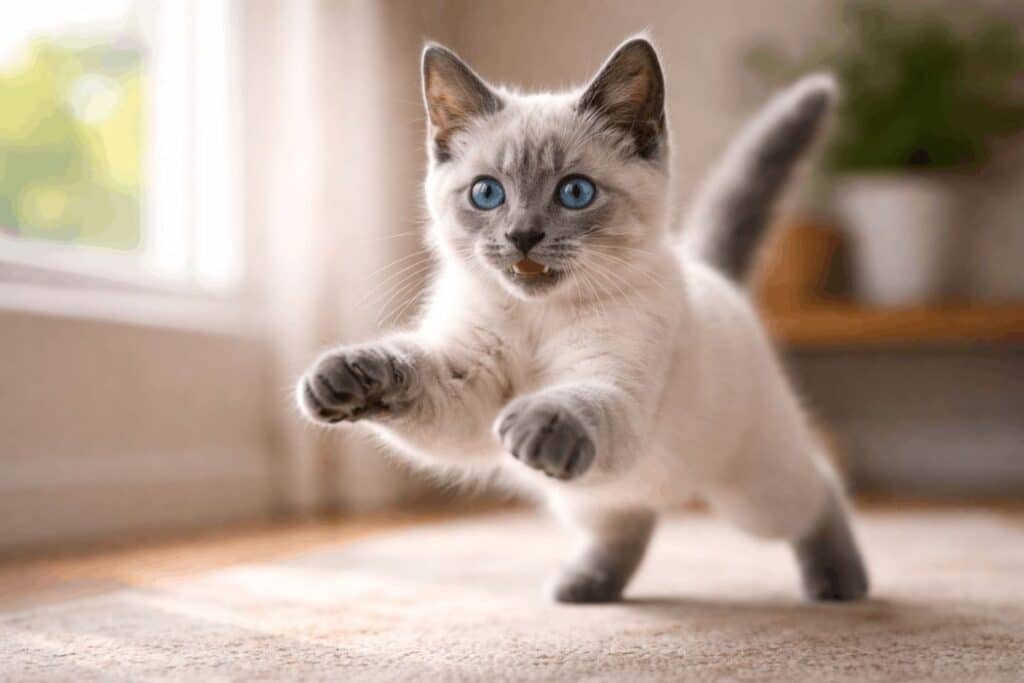
If you want an independent, aloof cat, stop reading now. The Blue Point Siamese is the opposite of that.
Owners and breeders consistently describe Blue Points as having a distinctly gentler, more laid-back temperament compared to other Siamese colors — particularly Seal Points, which tend to be more intense and demanding. Blue Points are still vocal and affectionate, but their energy tends to be calmer and more serene. Although I don’t own a Blue Point Siamese myself, I’ve spent years researching feline behavior and talking with many Siamese owners. One thing that comes up again and again is how closely these cats bond with their favorite person. Their constant need to stay nearby is one of the traits owners love most.
How They Behave Day-to-Day
They follow you everywhere. Blue Point Siamese do not understand the concept of personal space. They will follow you room to room, sit outside the bathroom door, and position themselves on whatever surface is closest to you at all times.
They talk constantly. The Siamese “Meezer” voice is legendary. Blue Points use a wide vocabulary of meows, chirps, trills, and what many owners describe as actual conversational tones. They get louder when ignored. If you talk back, expect a long discussion.
They bond to one or two people deeply. Unlike many breeds that spread affection broadly, Blue Points form intense primary bonds. Separation from their person causes genuine distress — including vocalizing, reduced eating, and behavioral changes.
They are trainable. This is where Blue Point Siamese surprise most people. They can learn to walk on a leash. They can play fetch. They respond to their name reliably. They can learn tricks using positive reinforcement. This intelligence is both their greatest asset and their most demanding quality.
They struggle with being alone. Siamese cats, including Blue Points, are among the highest-risk breeds for separation anxiety. A Blue Point left alone for 8–10 hours regularly may develop destructive behavior, over-grooming, or depression. This breed genuinely needs a companion — human or animal.
Personality Traits at a Glance
| Trait | Rating | Notes |
|---|---|---|
| Affection level | ⭐⭐⭐⭐⭐ | Extremely high — follows owner constantly |
| Vocalization | ⭐⭐⭐⭐⭐ | One of the loudest domestic breeds |
| Intelligence | ⭐⭐⭐⭐⭐ | Trainable, problem-solving, fetch-capable |
| Energy level | ⭐⭐⭐⭐ | High but calmer than Seal Points |
| Independence | ⭐ | Very low — dislikes being alone |
| Child-friendliness | ⭐⭐⭐⭐ | Good with respectful children |
| Dog-friendliness | ⭐⭐⭐⭐ | Adapts well with proper introduction |
| Stranger-friendliness | ⭐⭐⭐ | Moderate — bonds mainly with their family |
Blue Point Siamese Health Issues — What Every Owner Must Know
Blue Point Siamese are generally healthy cats with a lifespan of 12 to 15 years — some living to 18–20 with excellent care. However, as a purebred with specific genetics, they carry elevated risk for several conditions.
Common Health Issues
Dental disease is the most frequent issue in Siamese cats. Their jaw structure contributes to tartar buildup and gum disease. Daily tooth brushing — or at minimum weekly brushing — combined with annual professional dental cleanings is essential.
Amyloidosis is a serious hereditary condition seen in Siamese cats where abnormal protein deposits build up in organs, particularly the liver. There is no cure; early detection through blood panels every 1–2 years gives the best management options.
Strabismus (crossed eyes) is genetically linked to the same gene that causes point coloration in Siamese cats. Many Siamese have some degree of crossed eyes. It does not affect quality of life or vision significantly in most cases.
Nystagmus (rapid eye movement) is another neurological quirk linked to Siamese genetics. The eyes may move involuntarily. Most cats adapt completely and function normally.
Hypertrophic Cardiomyopathy (HCM) — thickening of the heart muscle — occurs in Siamese at higher rates than in mixed breeds. Annual cardiac screening by a veterinary cardiologist after age 5 is recommended.
Respiratory issues appear more commonly in Siamese than in many other breeds, particularly upper respiratory infections and asthma. Keep their environment smoke-free and monitor for wheezing or labored breathing.
Food allergies and sensitivities are more common in Siamese than in most breeds. Protein sources like beef or fish may trigger skin or digestive reactions in some individuals.
| Health Concern | Risk Level | Recommended Action |
|---|---|---|
| Dental disease | High | Weekly brushing, annual dental cleaning |
| Amyloidosis | Moderate | Blood panels every 1–2 years |
| Strabismus | High (genetic) | Monitor; usually no treatment needed |
| HCM | Moderate | Cardiac screening after age 5 |
| Respiratory issues | Moderate | Smoke-free environment; vet at first sign |
| Food allergies | Moderate | High-quality single-protein diet |
| Nystagmus | Moderate (genetic) | Monitor; usually self-compensating |
Blue Point Siamese Care Guide
Feeding
Blue Point Siamese do best on a high-protein, low-carbohydrate diet. Wet food is strongly preferred over dry kibble — their kidneys benefit from higher moisture intake, and Siamese cats are prone to urinary issues when chronically underhydrated.
Feed adult Blue Points 2–3 measured meals per day rather than free-feeding. They are prone to weight gain if food is left out continuously, and excess weight stresses their slender frames. Adult portions typically run 200–250 calories per day, depending on size and activity level.
Avoid fish-heavy diets long-term due to potential thiamine depletion. Rotate protein sources (chicken, turkey, rabbit) for nutritional balance.
Grooming
Their short, fine coat is genuinely low-maintenance. A weekly brush with a soft-bristle brush or grooming glove removes loose hair and distributes skin oils. They do not mat and shed moderately throughout the year.
Grooming schedule:
- Brushing: Once per week
- Nail trim: Every 2–3 weeks
- Ear cleaning: Monthly, or when visibly dirty
- Teeth brushing: Daily (ideal) or minimum 3× per week
- Bath: Only when necessary — most Blue Points tolerate water better than average cats
Exercise & Enrichment
Blue Points need a minimum 20–30 minutes of active play daily. Without it, boredom sets in quickly and leads to destructive behavior, excessive vocalization, or over-grooming.
Best enrichment options:
- Puzzle feeders — extends mealtime and engages problem-solving
- Wand toys — mimics hunting; rotate daily to maintain interest
- Leash walks — Blue Points adapt to harnesses better than most cats
- Cat trees with high vantage points — satisfies their need to observe
- A feline companion — the single most effective solution for separation anxiety
Living Environment
Blue Point Siamese are apartment-friendly when given adequate exercise and stimulation. They do not need outdoor access but benefit enormously from a catio or supervised outdoor time. They are indoor cats — their trusting nature and low survival instincts make unsupervised outdoor access dangerous.
They adapt poorly to households where everyone is away 8–10 hours daily unless a second cat is present. If your schedule involves long work days, seriously consider adopting two cats — ideally a bonded Siamese pair.
History & Origin of the Blue Point Siamese
The Siamese breed traces to ancient Thailand — then called Siam — where they were depicted in a manuscript called “Tamra Maew” (The Cat Book of Poems), created between 1350 and 1767 during the Ayutthaya period. They were kept by Thai royalty and Buddhist monks, considered sacred animals who could carry the souls of departed family members.
Siamese cats reached the Western world in the late 1800s. The Cat Fanciers’ Association formally recognized the Siamese breed in 1906.
Blue Points specifically have a documented history from 1894. However, their early reception was not always warm: at the 1896 Holland House Show, the famous cat artist Louis Wain refused to judge a Blue Point Siamese alongside Seal Points, insisting it could not be a true Siamese. His objection was overruled by history — the CFA recognized the Blue Point Siamese officially in 1934, two years before the UK’s GCCF followed in 1936.
Blue Point Siamese have appeared in popular culture too — Siamese cats (predominantly Seal Points) were featured in Disney’s “Lady and the Tramp,” “That Darn Cat,” and “The Incredible Journey.” They are also said to be indirectly responsible for Dorothy missing her balloon at the end of “The Wizard of Oz.”
For official breed standards and color recognition, the Cat Fanciers’ Association (CFA) provides detailed information about Siamese cats and their accepted color varieties.
Blue Point Siamese Price 2026 — Complete Breakdown
A Blue Point Siamese cat costs between $300 and $1,500 from a reputable USA breeder in 2026. Three factors drive the price: quality tier, breeder reputation, and location.
Price by Quality Tier
| Quality Tier | Price Range | What Is Included | Best For |
|---|---|---|---|
| Rescue / Shelter | $75–$300 | Spay/neuter, basic vaccines, microchip | Budget buyers, adopters |
| Pet Quality (registered) | $300–$800 | Health guarantee, vaccines, TICA/CFA registration | First-time owners, companions |
| Breeder Quality | $800–$1,200 | Champion lineage, full health testing, socialization records | Experienced owners |
| Show Quality | $1,200–$1,500+ | Show-ring standards, champion bloodlines, breeding rights | Breeders, show competitors |
Pet quality delivers identical personality and lifespan to show quality at significantly lower cost. Show quality costs more because of champion bloodlines and genetic testing ($320–$480 per breeding pair) — not because the cat makes a better companion.
Price by US Region
| US Region | Average Price Range | Notes |
|---|---|---|
| Northeast (NY, MA, CT) | $800–$1,500 | High demand — NYC market drives prices |
| Southeast (FL, GA, NC) | $500–$1,100 | Moderate demand, more breeders available |
| Midwest (IL, OH, MI) | $400–$900 | Lower cost of living = lower breeder prices |
| South (TX, LA, TN) | $450–$1,000 | Growing demand in Texas especially |
| West Coast (CA, WA, OR) | $700–$1,500 | California AB 485 compliance adds cost |
| Mountain West (CO, UT, AZ) | $500–$1,000 | Fewer registered breeders — waitlists common |
What a Reputable Breeder Must Include
Never purchase without these items confirmed:
| Item | Should Be Included | Red Flag If Missing |
|---|---|---|
| Age-appropriate vaccines | ✅ Yes | 🚨 Walk away |
| Health guarantee (minimum 2 years) | ✅ Yes | 🚨 Walk away |
| TICA or CFA registration papers | ✅ Yes | 🚨 Walk away |
| Microchip | ✅ Yes | ⚠️ Ask why not |
| Genetic health test results | ✅ Yes | ⚠️ Ask for details |
| Socialization documentation | ✅ Yes | ⚠️ Red flag |
| Breeder support after purchase | ✅ Yes | ⚠️ Quality indicator |
Year One Hidden Costs
| Expense | Estimated Cost | Notes |
|---|---|---|
| Initial vet visit + bloodwork | $150–$300 | Even if breeder provided vaccines |
| Spay or neuter (if not included) | $200–$500 | Essential |
| Pet insurance (annual) | $240–$600 | Recommended for purebreds |
| High-quality wet food (annual) | $400–$700 | Protein-rich diet essential |
| Litter and litter box | $100–$200 | Ongoing annual cost |
| Grooming tools | $30–$80 | One-time setup |
| Enrichment toys and cat tree | $100–$200 | Siamese need daily stimulation |
| Emergency vet fund | $200–$500 | Set aside — purebreds have higher vet costs |
| Year 1 Total (beyond purchase price) | $1,420–$3,080 | Per cat |
Lifetime cost: Blue Points live 12–15 years. At $1,000–$2,000 annually in maintenance, total lifetime ownership runs $12,000–$30,000 including purchase price. Plan for this before committing.
Blue Point Siamese Kitten vs Adult
| Factor | Kitten (0–1 year) | Adult (3+ years) |
|---|---|---|
| Energy level | Very high — constant play | Calmer, more settled |
| Coat color | Born white; points developing | Full color reached by age 2 |
| Bonding | Forms primary bond in first months | Can still bond deeply with new owner |
| Training window | Best time to teach leash, tricks | Possible but takes longer |
| Sleep needs | 16–18 hours/day | 12–16 hours/day |
| Price | Higher (more demand) | Lower (adult adoption often cheaper) |
Adult adoption is worth serious consideration. An adult Blue Point Siamese whose personality is fully established is often a better match — you see exactly what you are getting. Rescue adults also bond deeply with new owners who give them security and consistency.
Is a Blue Point Siamese Right for You?
Be honest with yourself before deciding.
| Your situation | Blue Point Siamese: Good fit? |
|---|---|
| Work from home or home most of day | ✅ Perfect match |
| Have another cat or dog at home | ✅ Excellent — reduces separation anxiety |
| Family with respectful children | ✅ Good match |
| Away 8–10 hours daily, no other pets | ❌ Not recommended |
| Want a quiet, independent cat | ❌ Wrong breed entirely |
| Enjoy vocal, interactive pets | ✅ Perfect match |
| First-time cat owner | ⚠️ Possible — but research their needs thoroughly |
| Live in a small apartment | ✅ Fine with adequate playtime |
Frequently Asked Questions
u003cstrongu003eQ: Is a Blue Point Siamese rare?u003c/strongu003e
Blue Points are moderately rare — less common than Seal Points but more available than Lilac Points. They are one of only four CFA-recognized Siamese colors.
u003cstrongu003eQ: How long do Blue Point Siamese cats live?u003c/strongu003e
Typically 12 to 15 years with proper care. Some individuals with excellent genetics and veterinary care reach 18–20 years.
u003cstrongu003eQ: Do Blue Point Siamese cats shed a lot?u003c/strongu003e
u003cbru003eModerate shedding year-round. Their short coat is much easier to manage than long-haired breeds. Weekly brushing keeps shedding under control.
u003cstrongu003eQ: Can Blue Point Siamese walk on a leash?u003c/strongu003e
Yes — Siamese adapt to harness and leash training better than most cat breeds. Start training as kittens for best results.
u003cstrongu003eQ: Are Blue Point Siamese good with dogs?u003c/strongu003e
Generally yes, with proper introduction. Their social, confident nature means they usually adjust to dog housemates well — especially if raised together.
u003cstrongu003eQ: What is the rarest Siamese color?u003c/strongu003e
Lilac Point is considered the rarest of the four CFA-recognized Siamese colors due to its complex genetics requiring both dilute and chocolate genes.
u003cstrongu003eQ: Do Blue Points have crossed eyes?u003c/strongu003e
Many do — strabismus (crossed eyes) is genetically linked to the same gene causing their point coloration. It does not significantly affect vision or quality of life.
u003cstrongu003eQ: What is a Blue Point Siamese’s favorite food?u003c/strongu003e
High-protein wet food — chicken, turkey, or rabbit-based. Avoid fish-heavy diets long-term. They thrive on quality wet food with minimal fillers or grain
Final Thoughts
The Blue Point Siamese is not a cat you choose for low maintenance. They choose you — follow you, talk to you, study you, and depend on you in ways that feel less like owning a cat and more like having a small, opinionated roommate who never pays rent but is always home.
For owners who want real companionship — a cat who greets you at the door, sleeps beside you, and genuinely misses you when you leave — no breed delivers that more fully than a Blue Point Siamese.

Wahsay Ahmed is the founder of FelineNest and a cat care writer. His interest in feline health began in 2023 after adopting two cats, Whisker and Mochi. Since then, he has spent two years studying trusted veterinary resources, feline behavior, nutrition, and preventive care while applying that knowledge through daily care of his own cats.