What can I feed a kitten — this is one of the most important questions any new cat owner can ask. A kitten’s diet during the first year directly affects growth, brain development, immunity, and long-term health. Many new owners are unsure which foods are safe and which are dangerous. This guide covers the best kitten foods, safe human foods, toxic ingredients to avoid, and emergency feeding options.
Cats are obligate carnivores — this is not a preference, it is a biological requirement. Unlike dogs or humans, cats cannot synthesize essential nutrients from plant sources. They must get taurine, arachidonic acid, preformed vitamin A, and specific amino acids directly from animal protein. Without these, kittens develop serious and irreversible health problems, including heart disease, blindness, and neurological damage.
Dr. Jennifer Coates, DVM — veterinarian with over 30 years of experience — explains that kittens need a diet specifically formulated to support their extraordinary growth rate. Within six months, kittens achieve approximately 75% of their adult body mass. That level of development requires precisely calibrated levels of protein, fat, calcium, DHA, and calories that adult cat food simply does not provide.
Why Kitten Food Is Not the Same as Adult Cat Food
Adult cat food is formulated for maintenance — keeping a healthy adult cat at a stable weight with adequate basic nutrition. Kitten food is formulated for rapid growth and development. The differences are significant.
| Nutrient | Kitten Food Minimum | Adult Cat Food Minimum | Why Kittens Need More |
| Protein | 30% (dry matter) | 26% (dry matter) | Muscle development, organ growth |
| Fat | 18–25% | 9% minimum | Brain development, energy for rapid growth |
| DHA | Added (omega-3) | Not required | Brain and vision development |
| Calcium | Higher level | Lower level | Bone density formation |
| Taurine | Required | Required | Heart function, vision, reproduction |
| Calories | Higher density | Lower density | Fueling rapid metabolism |
Feeding adult cat food to a kitten under 12 months is not just suboptimal — it is genuinely harmful over time. The protein and calorie deficit can result in stunted growth, poor muscle development, and immune deficiencies. Never substitute adult food for kitten food, even temporarily, if it can be avoided.
What to Feed a Kitten by Age — Newborn to 12 Months
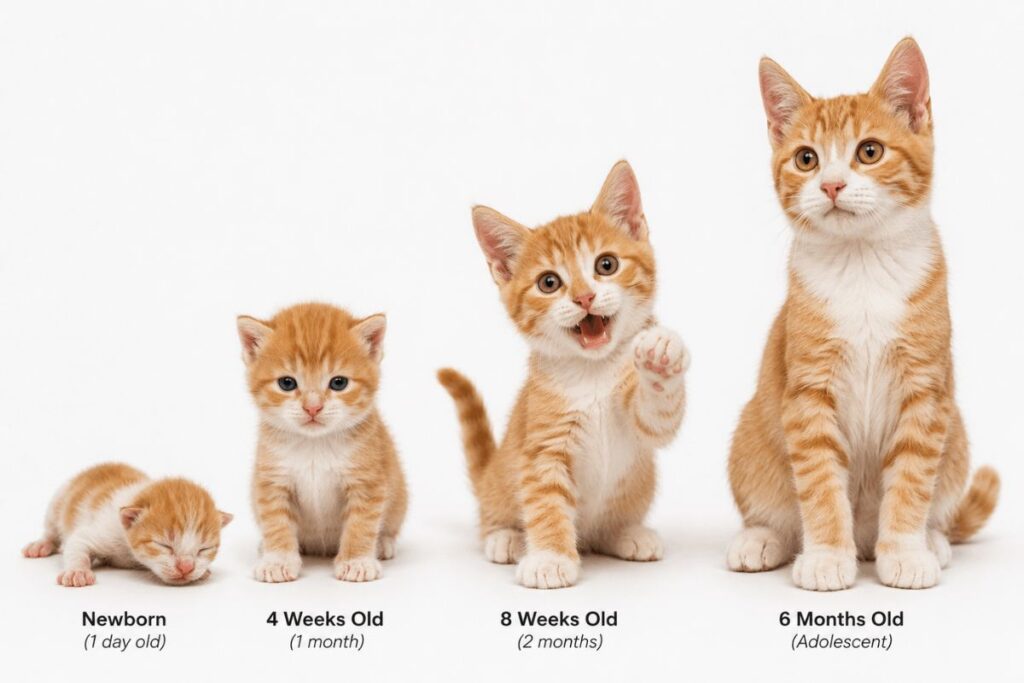
What a kitten can eat changes dramatically in the first year of life. Here is a clear age-by-age guide.
| Age | Primary Food | Secondary | Notes |
| 0–4 weeks | Mother’s milk | Nothing — milk only | Best nutrition available; do not supplement unless orphaned |
| 0–4 weeks (orphaned) | Kitten milk replacer (KMR) | Nothing | Never use cow’s milk — it causes diarrhea and nutritional deficiency |
| 4–6 weeks | Mother’s milk + wet kitten food introduction | Small amounts only | Mix wet food with a little warm water to soften |
| 6–8 weeks | Wet kitten food primary | Kitten kibble soaked in water | Weaning complete by 8 weeks in most cases |
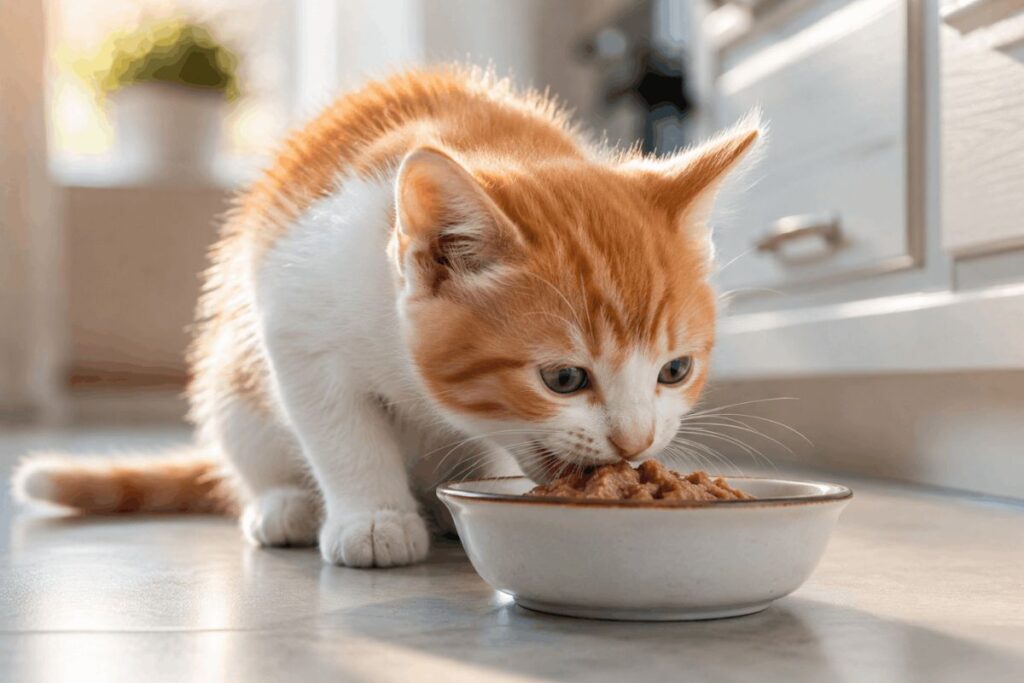
| 8 weeks–6 months | High-quality wet kitten food | Dry kitten kibble supplement | 3–4 small meals per day |
| 6–10 months | Wet kitten food + dry kitten kibble | Reduce to 3 meals/day | Begin transitioning toward 2–3 meals |
| 10–12 months | Begin transitioning to adult food | 7–10 day gradual switch | Large breeds (Maine Coon) may need kitten food until 18 months |
The Best Foods You Can Feed a Kitten
The absolute best thing you can feed your kitten is a commercially prepared kitten formula from a reputable brand. This is not a cop-out answer — it is the reality that decades of veterinary nutritional research support. Commercial kitten foods from trusted brands are formulated, tested, and verified to be complete and balanced in ways that no home-prepared diet can match without significant veterinary nutritionist guidance.
When I first adopted a young kitten, I assumed any soft food was safe. After giving too much tuna as a treat, she developed an upset stomach and refused her regular kitten food. That experience taught me that balanced kitten food is always the safest choice, while human foods should only be occasional treats.
Commercial Kitten Food — The Gold Standard
Kinship’s veterinary nutrition team is direct about this: “The advantage of quality commercial kitten diets is that they are ‘complete and balanced,’ meaning they provide all the necessary nutrients without needing additional supplements.”
When choosing a commercial kitten food, look for these three things on every label:
- AAFCO statement: The label must say the food “is formulated to meet the nutritional levels established by the AAFCO Cat Food Nutrient Profiles for growth and reproduction.” This is non-negotiable.
- Named animal protein as the first ingredient: Chicken, turkey, salmon, or another specific meat — not “meat by-product” or “poultry meal” as the primary ingredient.
- Brand research commitment: PetMD recommends brands like Purina, Hill’s, Royal Canin, and IAMS because these companies conduct feeding trials, employ board-certified veterinary nutritionists, and back their formulas with published research.
Wet Food vs Dry Kibble — Which Should You Choose?
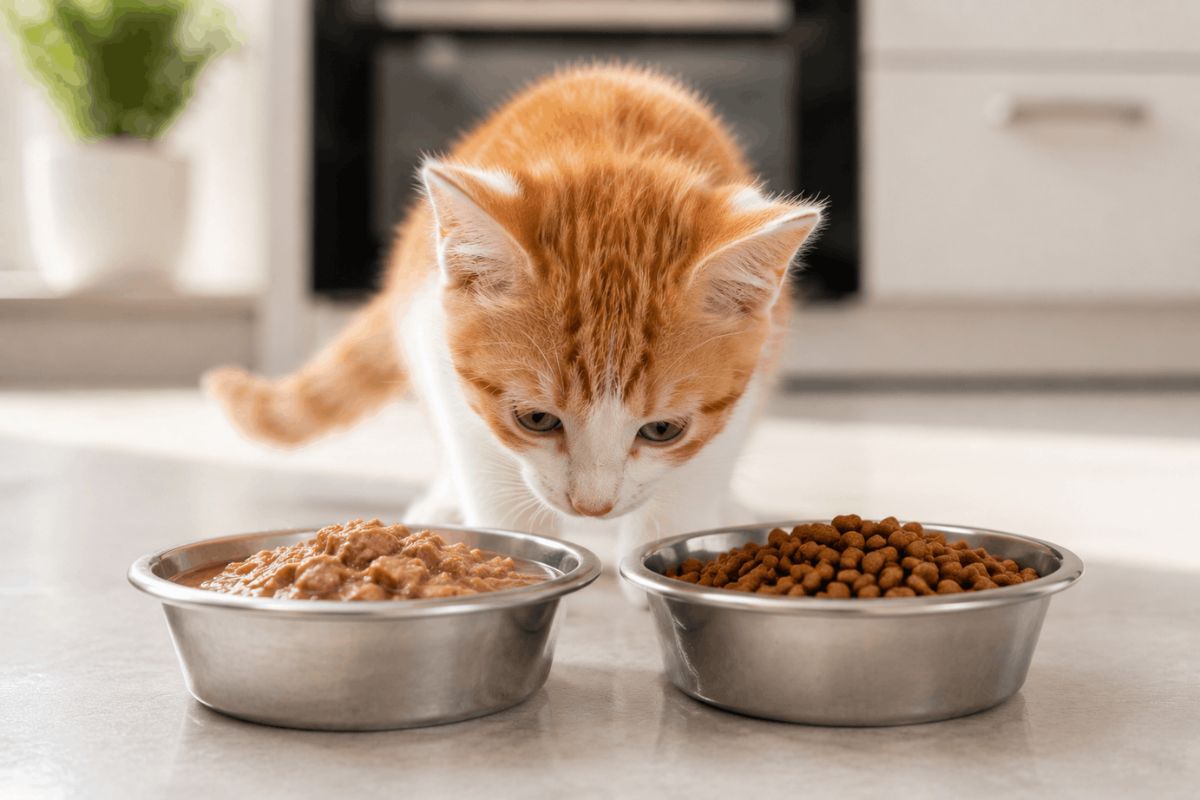
Both wet and dry food have legitimate roles in a kitten’s diet — but they are not equal.
| Factor | Wet Kitten Food | Dry Kitten Kibble |
| Moisture content | 75–85% | 8–12% |
| Hydration support | Excellent | Poor — kitten must drink separately |
| Protein quality | Higher animal protein | Often includes plant proteins |
| Palatability | Usually preferred | Variable |
| Dental benefits | Minimal | Some — rough texture reduces plaque |
| Caloric density | Lower per volume | Higher per volume |
| Cost | Higher per meal | Lower per meal |
| Best use | Primary food source | Supplement or free-fed |
| Shelf life (opened) | 20–30 minutes max | All day — safe to leave out |
Veterinary consensus: wet food should form the majority of a young kitten’s diet, especially in the first 6 months. Kinship notes that wet food’s high water content eases the transition from milk to solid food and keeps kittens hydrated at a stage when they are not yet reliable water drinkers.
What Human Foods Can I Feed a Kitten?
This is the question most kitten owners really want answered. The honest answer: Some human foods are completely safe for kittens in small amounts. Many are not. And for kittens specifically — whose digestive systems are more fragile than adult cats — extra caution is always warranted.
The critical rule before we go further: human food should never exceed 10% of a kitten’s daily calorie intake. Beyond that threshold, you risk disrupting the nutritional balance of her primary diet.
Safe Human Foods for Kittens (With Rules for Each)
| Human Food | Safe for Kittens? | Rules | Serving Size |
| Cooked chicken (boneless, skinless) | ✅ Yes | Plain only — no seasoning, no skin, no bones | 1 small bite as treat |
| Cooked turkey (boneless) | ✅ Yes | Same as chicken — boiled or baked only | 1 small bite as treat |
| Cooked salmon | ✅ Yes | No skin, no bones, no seasoning | 1 small bite, not daily |
| Cooked tuna | ✅ Limited | Small amounts only — not as a primary food | Occasional small piece |
| Plain cooked egg | ✅ Yes | Scrambled or boiled, no butter, no oil, no salt | A few small pieces |
| Plain canned pumpkin | ✅ Yes | No spices, no pie filling — plain only | 1 teaspoon max |
| Cooked plain rice | ✅ Limited | Only as a temporary bland diet aid | Small amount with protein |
| Blueberries | ✅ Yes | Fresh, washed, cut in half | 1–2 berries max |
| Plain cooked broccoli | ✅ Yes | Steamed only, tiny pieces | A tiny floret |
| Cooked carrots | ✅ Yes | Soft-cooked, no seasoning, tiny pieces | 1–2 small pieces |
| Watermelon (seedless) | ✅ Yes | No rind, no seeds | Half-inch cube |
One critical note about tuna: while cats love it, tuna is not nutritionally complete. PetMD warns that a diet heavy in tuna can lead to vitamin E and K deficiencies and mercury toxicity over time. A bite as a treat is fine. Tuna as a meal replacement is not.
The 10% Rule — How Much Human Food Is Too Much?
Most sources agree on the same guideline: human food and treats combined should not exceed 10% of your kitten’s daily calorie intake. Here is what that looks like in practice.
A typical 3-month-old kitten needs approximately 200 calories per day. Ten percent of that is 20 calories. A small piece of cooked chicken (about 1 inch square) contains roughly 10 to 15 calories. That means your kitten can have one to two small bites of appropriate human food per day as a treat — and that is the limit.
Exceeding this regularly disrupts the nutritional balance of the kitten’s primary diet and can cause obesity, digestive issues, and nutrient deficiencies over time.
Foods That Are Toxic and Dangerous for Kittens
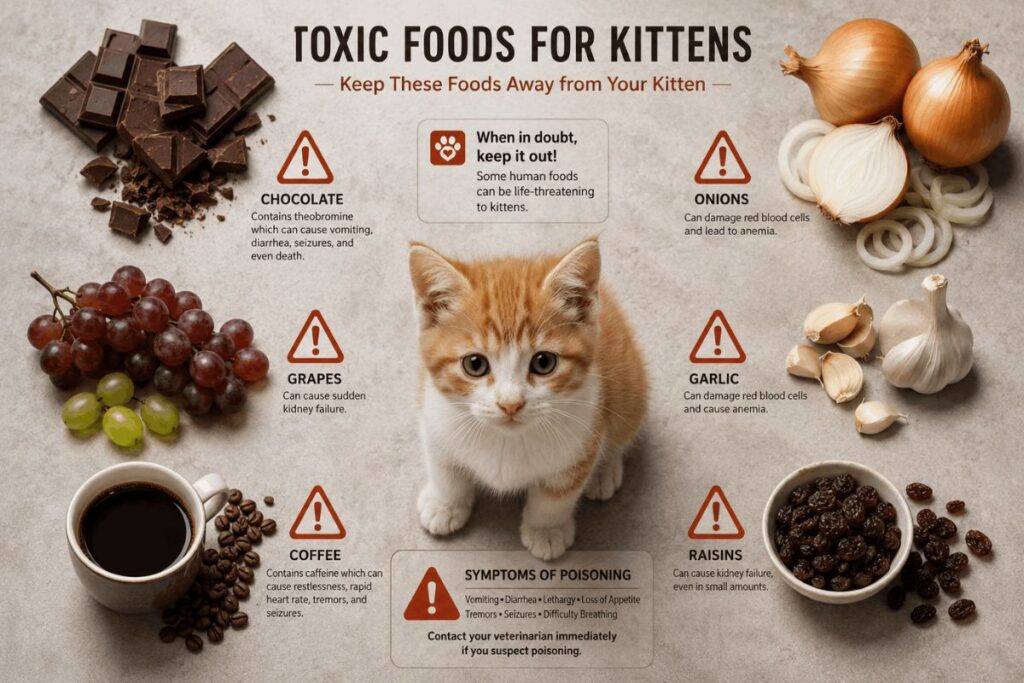
This section could save your kitten’s life. Many of the foods below are regularly found in homes, and some are so common that owners give them to kittens without realizing the danger. Print this list. Learn it.
Immediately Toxic — Never Feed These Under Any Circumstances
| Food | Why It Is Toxic | What Happens |
| Onions and garlic (all forms) | Sulfur compounds destroy red blood cells | Hemolytic anemia — can be fatal |
| Chocolate (all types) | Theobromine — cats cannot metabolize it | Heart arrhythmia, seizures, death |
| Caffeine (coffee, tea, energy drinks) | Methylxanthines — highly toxic to cats | Rapid heart rate, tremors, seizures |
| Grapes and raisins | Mechanism unknown — causes kidney failure | Acute renal failure |
| Xylitol (sugar-free products) | Causes insulin release and hypoglycemia | Liver failure, seizures |
| Alcohol (any form) | Extremely toxic in tiny amounts | Respiratory failure, death |
| Raw bread dough | Yeast ferments in the stomach, producing alcohol | Bloating, alcohol poisoning |
| Macadamia nuts | Mechanism unknown — neurological effects | Weakness, tremors, hyperthermia |
Even small quantities of onion, garlic, or chocolate can cause serious harm. The theobromine in dark chocolate is particularly dangerous — Cats Protection UK notes that just 2g of chocolate (smaller than one square) is enough to cause serious damage. If you suspect ingestion of any of these, call your vet or the ASPCA Animal Poison Control Center immediately.
Commonly Misunderstood Foods — Milk, Raw Meat, and More
Several foods are widely believed to be safe or even beneficial for kittens — but are actually problematic.
Cow’s milk: The classic image of a kitten lapping milk from a saucer is one of the biggest myths in cat care. Purina’s nutrition team explains that while kittens can digest their mother’s milk thanks to a specific enzyme, most cats lose the ability to process lactose after weaning. Cow’s milk causes diarrhea in most cats and provides no meaningful nutrition. Never use cow’s milk as a kitten milk substitute.
Raw meat and fish: The CDC does not recommend feeding raw pet food to cats. Raw chicken, fish, and eggs may contain Salmonella, E. coli, or parasites like Toxoplasma that can cause serious illness in both your kitten and your family. Cook all meat thoroughly before offering any to your kitten.
Dog food: Dog food is not toxic to kittens, but it is nutritionally inappropriate. Dog food does not contain adequate taurine for cats. A kitten fed dog food long-term will develop taurine deficiency — leading to dilated cardiomyopathy and vision problems.
Tuna in large amounts: A small piece is fine. Daily tuna as a staple food is not. Mercury accumulation and nutritional deficiencies develop from over-reliance on tuna.
What Can I Feed a Kitten in an Emergency?
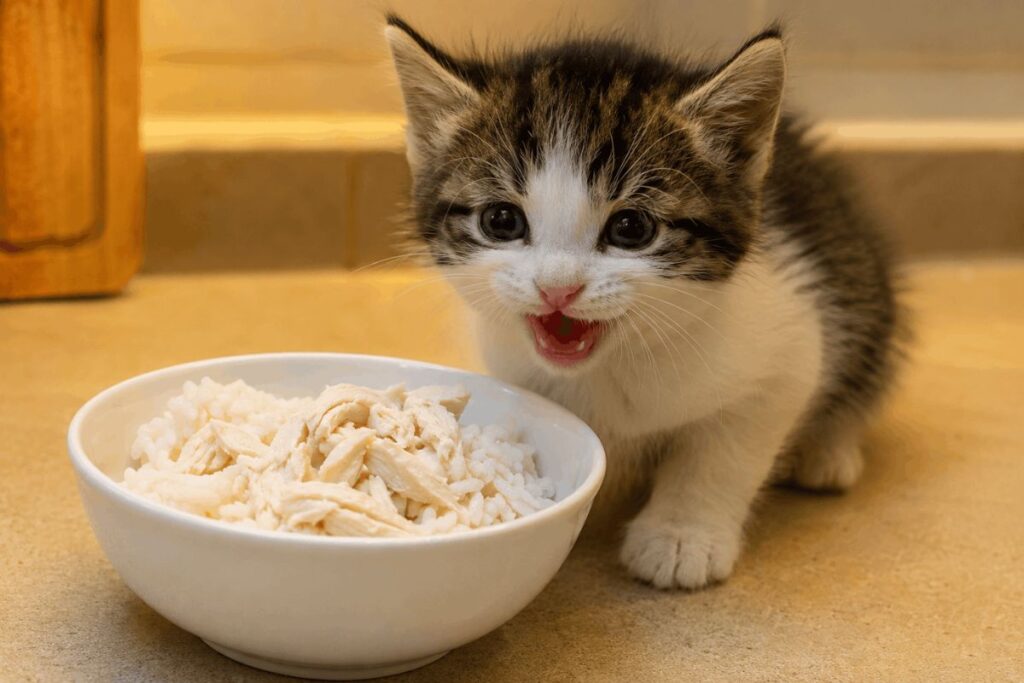
It is 10 p.m. You just ran out of kitten food. The pet store is closed. What can you safely feed your kitten until morning?
Kinship’s nutrition team provides the answer: “In an emergency, a kitten can eat a single meal of mostly protein — chicken, ground beef or turkey — with some cooked egg and cooked white rice.”
Here is a simple emergency meal plan:
| Emergency Option | How to Prepare | Serve How Much | Notes |
| Plain boiled chicken | Boil without seasoning, remove bones and skin | A few small pieces | Best emergency option — easily digestible protein |
| Plain cooked ground turkey | Cook thoroughly, no seasoning | A few small pieces | Second-best option |
| Plain scrambled egg | No butter, no oil, no salt | A tablespoon | Good protein source |
| Plain cooked white rice + chicken | Mix together | Small portion | Bland and easy on the stomach |
| Plain canned tuna in water | Drain thoroughly, no oil, no salt | Small amount | Only one time — not nutritionally complete |
This emergency meal is not nutritionally complete for a kitten. It is a safe one-time solution. Do not continue beyond one meal without proper kitten food. An abrupt diet change also risks digestive upset — so return to regular kitten food as soon as possible.
The Real Owner Story — The Kitten Who Got Tuna for a Week
David from Phoenix adopted a 10-week-old tabby named Pesto in January 2025. He ran out of kitten food on a Sunday night and fed Pesto tuna from a can. Pesto loved it enthusiastically. David, seeing the enthusiastic response, continued feeding tuna for the rest of the week, reasoning that since Pesto ate it happily, it must be fine.
By Thursday, Pesto had soft stools and was noticeably less energetic. By Saturday, he had stopped eating entirely.
The vet diagnosed mild vitamin E deficiency and digestive disturbance from the high sodium content and nutritional imbalance of a week of canned tuna. Treatment was straightforward — but David had unknowingly created a second problem: Pesto had become so accustomed to tuna that he refused his kitten food for three weeks afterward.
“The vet told me tuna is like candy for cats,” David said. “One night was fine. Seven nights created a preference I couldn’t undo easily.”
The lesson: emergency feeding is for emergencies only — one meal, then back to proper kitten food.
Feeding Mistakes Most New Owners Make
Even well-intentioned owners make these mistakes consistently. Here are the six most common — and how to avoid them.
| Mistake | Why It Happens | The Fix |
| Feeding adult cat food to a kitten | No kitten food available, or cost savings | Always buy kitten-specific food — the nutritional difference is critical |
| Giving cow’s milk as a treat | Cultural myth / looks cute | Use water — never cow’s milk |
| Feeding tuna or human food as a primary diet | Kitten loves it, owner assumes = good | Human food is a treat, never a meal replacement |
| Switching food abruptly | Urgency, convenience | Always transition over 7 to 10 days |
| Leaving wet food out all day | Convenience | Wet food spoils in 20–30 minutes — discard and replace |
| Not varying protein sources early | One food the kitten likes | Vary proteins from 8 to 12 weeks to prevent picky eating as an adult |
The last point deserves special attention. Purina’s nutrition team notes that a kitten’s food preferences are largely set by 6 months of age. Introducing a variety of textures and protein sources before that window closes dramatically reduces the risk of raising an adult cat who refuses everything except one brand of one flavor.
My Experience Feeding a Young Kitten
When I brought home my first kitten, I assumed she could eat almost anything soft and harmless-looking. One night, I gave her too much tuna because she loved it so much. By the next morning, she had diarrhea and completely ignored her regular kitten food. That experience taught me how sensitive a kitten’s stomach can be and why balanced kitten nutrition matters far more than simply feeding foods they enjoy.
Final Thought
What can you feed a kitten? The short answer is: high-quality commercial kitten food as the foundation, small amounts of safe human food as occasional treats, and nothing from the toxic list — ever.
The longer answer is that what you feed your kitten in the first 12 months of her life directly shapes her health for the next 15 years. Good nutrition at this stage builds strong bones, a healthy heart, sharp vision, and a resilient immune system. Poor nutrition — or too much of the wrong foods — creates deficits that cannot always be corrected later.
When in doubt, ask your vet. And when there is no cat food in the house, one meal of plain boiled chicken will see you through the night.
Frequently Asked Questions
What can I feed a kitten if I have no cat food?
In an emergency, offer plain boiled chicken, cooked turkey, or scrambled egg with a little plain rice. Use this only temporarily until proper kitten food is available.
Can kittens eat chicken or tuna?
Yes. Plain cooked chicken is safe, while tuna should be given only occasionally and in small amounts.
Can kittens drink cow’s milk?
No. Most kittens are lactose intolerant after weaning, and cow’s milk can cause diarrhea.
What vegetables are safe for kittens?
Small amounts of cooked carrots, peas, broccoli, or plain pumpkin are safe as occasional treats.
What foods are toxic and dangerous for kittens?
Avoid onions, garlic, chocolate, grapes, raisins, caffeine, xylitol, and alcohol, as they can seriously harm kittens.

Wahsay Ahmed is the founder of FelineNest and a cat care writer. His interest in feline health began in 2023 after adopting two cats, Whisker and Mochi. Since then, he has spent two years studying trusted veterinary resources, feline behavior, nutrition, and preventive care while applying that knowledge through daily care of his own cats.